CPP Students Assist Planetary Protection
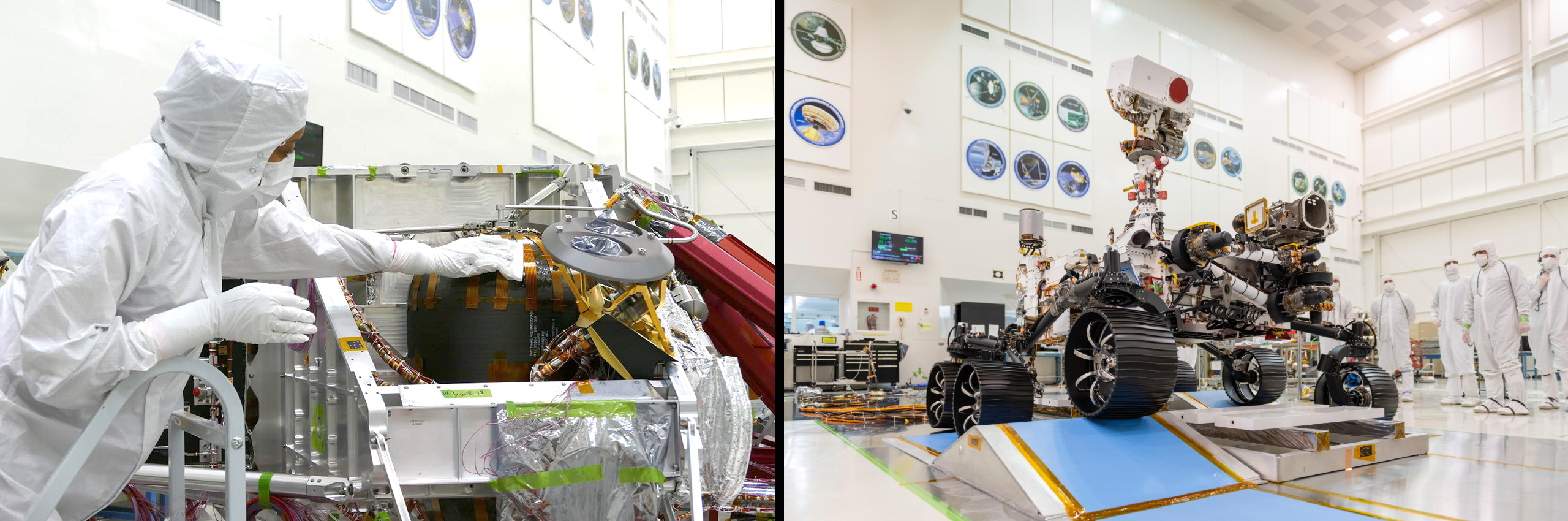
The phrase “planetary protection” may conjure up images of Star Trek’s prime directive not to interfere with the development of other worlds. While the fictional directive was aimed at civilizations, NASA’s Biotechnology Planetary Protection Group seeks to prevent microbial contamination. CPP is actively involved in that work because of biochemistry Professor Rakesh Mogul.
Scientists have known for years that microbes are present in NASA clean rooms where spacecraft are built. DNA analysis tells us they’re there. What isn’t known is whether they’re alive, or dead, or just dormant.
In 2018 Mogul and Assistant Professor Gregory Barding, along with 22 students, published a paper showing that a bacteria called Acinetobacter found on surfaces cleaned with alcohol, could actually use the alcohol as a food source.
Mogul said, “We showed that several spacecraft-associated Acinetobacter metabolize or biodegrade the spacecraft cleaning reagents of ethanol (ethyl alcohol), 2-propanol (isopropyl alcohol), and Kleenol 30 (floor detergent).”
They did their work in a CPP lab. The next phase which was funded in 2020 was to bring samples from the clean room to CPP and observe how actual clean room bacteria metabolizes the cleaning agents.
Mogul is PrincipaI Investigator on the grant from the Planetary Protection Research element of NASA Research Opportunities in Space and Earth Sciences (ROSES) program. The total grant award is $420,000 with two-thirds going to CPP and one-third to JPL. JPL Scientist, Parag Vaishampayan serves as Co-Investigator.
The collaboration with JPL/NASA means that students also get a chance to conduct research there. Unfortunately, the pandemic has prevented that from happening. Graduate student Daniel Miller is an exception because his work at JPL is considered mission essential.
Eight months into the pandemic Mogul was able to bring some students to campus for lab work but confides that the pandemic has set the research back about a year.
Graduate student Juan Aldaco, who has been conducting research with Mogul since 2019, returned to the lab in early 2021. He is observing metabolic growth of Acinetobacter under simulated clean room conditions.
Aldaco, who has a bachelor’s in chemistry, said he’s learned a lot of microbiology. “I also developed the ability to keep track of data and generate graphs from data analysis,” he said.
Graduate student Demi Ayala said, “I was excited to do more analytical chemistry in this lab because working with instruments wasn’t something I had a lot of experience in. It’s also what a lot of industry employers want.”
An ultimate goal of the research is to catalog the bacteria that can survive clean room conditions so that if signs of life are detected elsewhere they can be compared to what might’ve been brought by our spacecraft. That would allow scientists to rule out contamination.
The work of Mogul and his team has already yielded enough results for two papers that are being prepared for publication. Their research has implications not just for space exploration but also for hospital operating rooms and pharmaceutical clean rooms.
Aldaco plans to work in the medical field, and Ayala wants to work for a company that will use science to mitigate the effects of pollution and climate change.
Miller feels his CPP research experience helped prepare him for work. He said, “My strong foundation in microbiology, and my experience working with spacecraft associated microorganisms in low nutrient environments are the reasons I'm doing mission essential work at JPL.”


