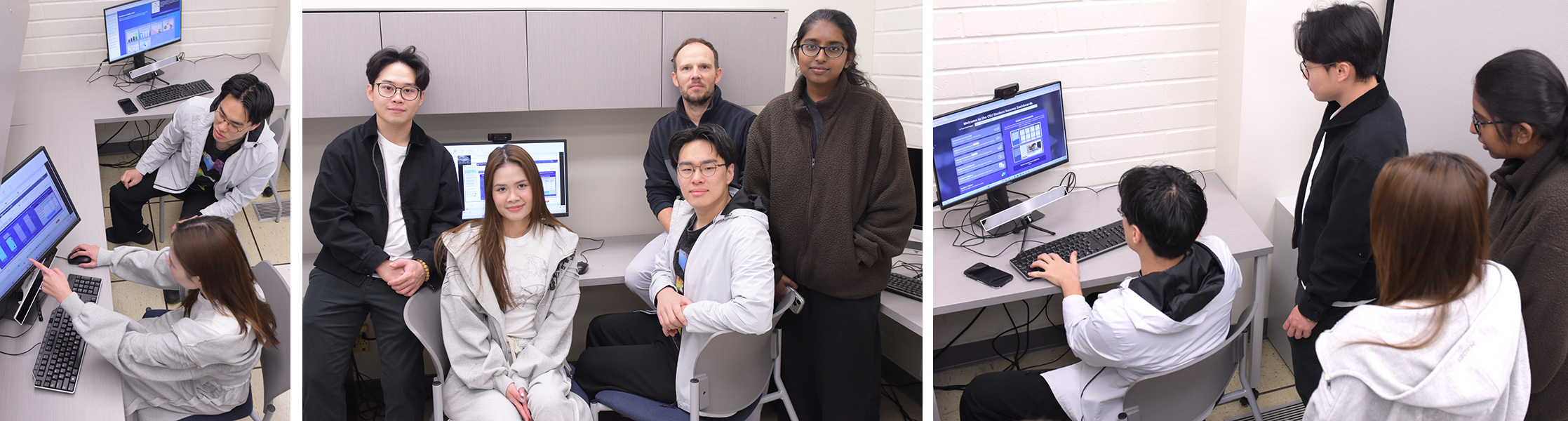
Center photo (from left to right) Khoi Tran, Trang Tran, Brad Kim, Associate Professor Ben Steichen, Keerthi Sreeram.
As the use of AI grows, the human-computer interface becomes more important than ever. At Cal Poly Pomona’s Human-centered, Adaptive, and Personalized Information Interaction (HAPII) lab, teams of computer science students are working on improving how people acquire and interact with information. The students are led by Associate Professor Ben Steichen.
MULTILINGUAL SEARCH
Steichen and his students are researching how to improve search, recommendations, and education for people who are multilingual. “People think, if you speak a language, you should get search results just in that language. In California, 43% speak another language at home, yet we treat everyone as monolingual,” Steichen said.
The way systems are setup now, the data is in silos and not linked. Steichen’s lab seeks to integrate multiple languages on the screen. They’re using sophisticated eye-gaze technology to see how people interact with different languages, and machine learning to build a model of how a person proficient in a given language interacts with data. After that, the experience can be personalized for them. They hope to scale the research using the basic cameras that come with most devices.
Building a model is important because it allows the researchers to understand people’s language preferences for different types of information. For example, a person may prefer their native tongue for learning new things, but another language for healthcare or finance.
MULTILINGUAL MATH EDUCATION
For improving multilingual STEM education, Steichen’s lab has partnered with Alyssa Kermad from CPP linguistics, and faculty at Santa Clara University. Steichen said, “As an educator we assume STEM is language agnostic because a math formula is the same in English or Spanish. The problem is, the teacher teaches the concepts through language, so the question is, ‘how do we link the language with the knowledge.’”
For Spanish learners, they’ve built a series of math mini-games which includes word-matching, rearranging, and exercises to improve understanding.The apps were trialed in a 4th grade class in Walnut. Santa Clara works with parents and kids in a Saturday educational enrichment program.
Computer Science senior Antonio Loyola is working on the core game functionality using the Flutter framework. He said, “This multilingual math project supports learners whose second language is English by scaffolding mathematical understanding as they transition from their primary language to English. The application integrates language-assist features to reduce linguistic barriers while preserving mathematical rigor.”
Loyola graduates May 2026 and already has a job lined up to work as a software engineer for Walmart Global Tech.
DATA VISUALIZATION
Students from the HAPII Lab are also getting hands-on experience creating a student success data visualization dashboard for the Chancellor’s Office. Senior Brad Kim said, “It allowed me to grow as a student and bridge the gap between education and industry.” Kim shared that he already has a full-time job offer as a junior software developer at Amazon when he graduates in May 2026.
Trang Tran is a master’s student in Steichen’s lab. Her ultimate goal is to work on dashboards, analytics platforms, or internal products and turn complex data into something that’s clear and impactful for users. CPP has prepared her to do that.
“Working on the Chancellor’s Student Success Dashboard has felt like real-world engineering. I’ve had to build features that are used by an actual client which taught me how to balance technical quality with real deadlines and changing requirements. It also strengthened my ability to translate stakeholder feedback into concrete user interface and backend changes, communicate progress clearly, and make sure the end result is reliable, consistent, and easy for non-technical users,” Tran said.
Steichen’s lab is known for their expertise in visualization and search. That’s why the Chancellor’s Office asked them to collaborate on the dashboard. A group of six students are working on the project. “It’s an internship in software engineering, working on software that’s live. They get to work with engineers, data scientists, designers, and project managers,” Steichen said.
Visual literacy is a skill just like language literacy. In the lab, they’re using eye tracking equipment to discover which visualizations are failing. The way people’s eyes move across a graph or image can tell them if the user is finding what they need. They’re also working on visual search and AI chatbots.
Steichen has teamed up with the Department of English and Modern Languages to develop what might be the first cross-college minor at CPP - AI and Linguistics. Students will learn how to analyze linguistics computationally, which is essential for the natural language processing (NLP) that makes conversational AI like ChatGPT possible.


