NSF Grant Funds use of AI to Increase Mobility Scooter Safety
Professor Tingting Chen from the Department of Computer Science has acquired an NSF grant to improve safety for individuals using mobility scooters. Machine learning will be used to evaluate users’ ability to safely maneuver the mobility scooters, providing a valuable tool to doctors and physical therapists, as well as the users themselves.
Cal Poly Pomona, a Hispanic Serving Institution (HSI), will collaborate with an interdisciplinary team from another HSI - University of Texas, San Antonio (UTSA) and partner with Casa Colina Hospital, and Center of Achievement, CSU Northridge.
“Medical informatics has always been an interest of mine,” Chen said. “Doctors may prescribe a scooter and therapists work with patients but many patients have multiple diagnoses with symptoms that change or progress over time. This will be a tool that we think can improve safety and prevent injury and death.”
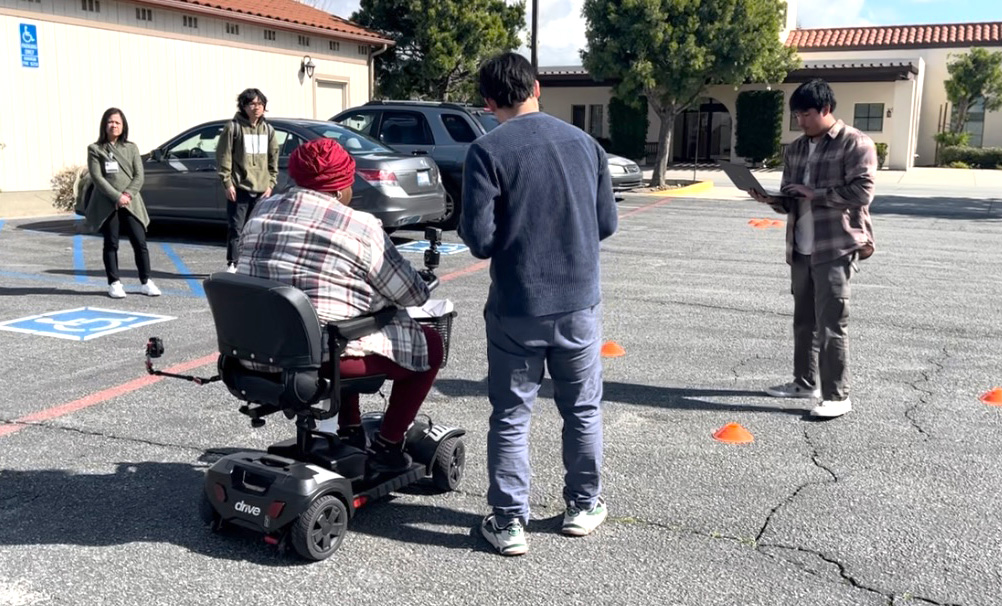
The team will use sensors attached to a raspberry pi board. The sensors will monitor scooter motion, acceleration, and capture video of the driver.
CPP Assistant Professor Mai Narasaki-Jara from kinesiology and health promotion will work with Chen to provide the expertise needed to train the software. “She invited me to participate because of my background in biomechanical movement analysis in individuals with disabilities. My research specialty involves gait and balance analysis,” Narasaki-Jara said.
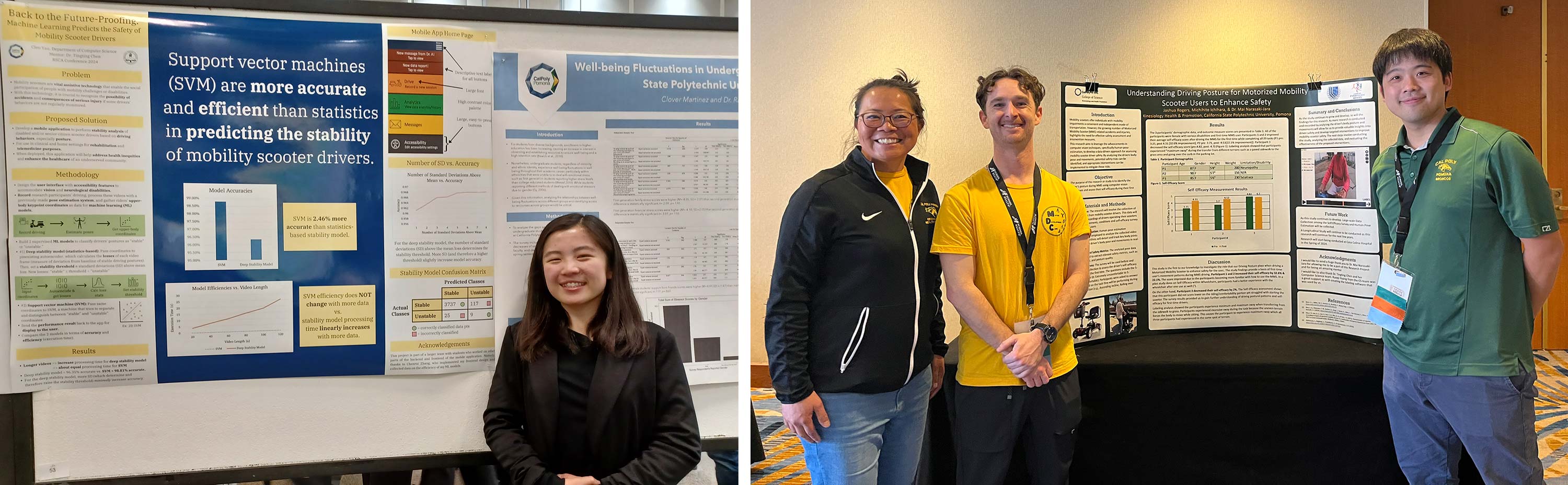
Kinesiology students will gain experience conducting movement analysis, investigating postural sway, and self-efficacy in the use of a Mobility Scooter for first-time users. “I'm assessing and looking for things that help with qualitative data such as when their posture changes and why it does. I also help with labeling, using software created by the computer science team,” graduate student Joshua Rogers said. Rogers is working on a master’s in adapted physical education.
Computer science student Cleo Yau developed two machine learning models that they are using to evaluate driver safety. One model is a support vector machine and the other is based on the statistics of their input data. “We record videos of driver’s upper bodies and collect their key body point coordinates. The kinesiology team looked at the videos frame by frame and labeled them stable or unstable. Each set of coordinates was used to train the machines to evaluate driver stability,” Yau said.
The ultimate goal will be to have software on a mobile device for the mobility scooter driver and a desktop app for doctors and therapists. “I did the front-end design of the mobile application. I learned about making interfaces more accessible and I realized how many applications are not accessible,” Yau said.
“I gained insights into various research methodologies, data collection techniques, and analysis procedures. This research experience also gave me opportunities to improve my professional communication skills and learn how to conduct collaborative research,” kinesiology graduate student Michihito Ichihara said.
Yau, who graduates in May and wants to work in machine learning and AI, said, “The ultimate goal is to do something that will positively affect the community. Accessible technology can support marginalized communities. That’s why I like this, because it will have an impact.”