Shining a Light on Dark Matter
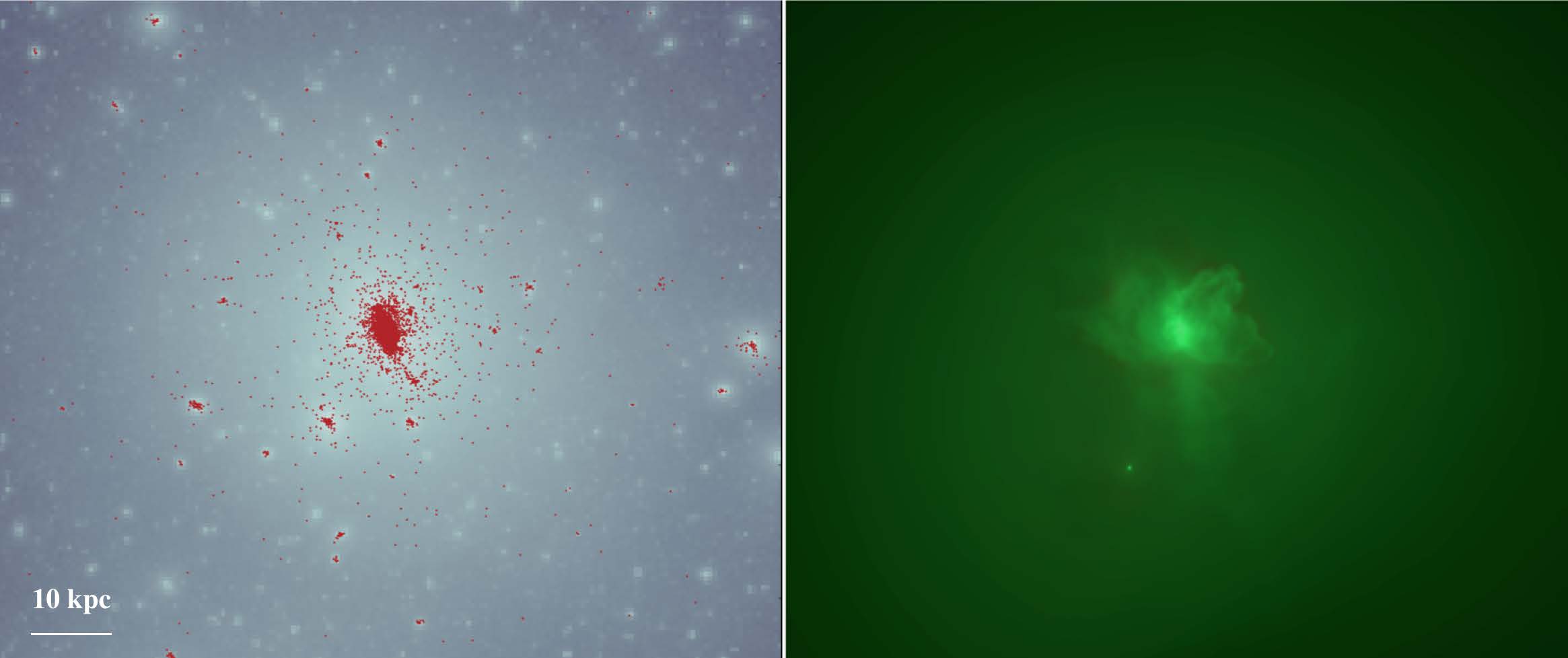
Left: Visualization of the dark matter (grey) and stellar distribution (red) of a dwarf galaxy. Right: Gas density for the same dwarf shown at the same scale.
Assistant Professor Coral Wheeler from the Department of Physics and Astronomy received a LEAPS-MPS grant from the National Science Foundation. The acronym stands for Launching Early-Career Academic Pathways in the Mathematical and Physical Sciences and is designed to support the work of pre-tenured faculty, particularly at minority-serving, and primarily undergraduate institutions.
Wheeler’s research is titled, The Tiniest galaxies in the Universe as Testbeds of Fundamental Physics. Wheeler said the work will address questions like, “What is the nature of dark matter? What were the conditions of the early universe? Do galaxy formation models accurately describe all galaxies?”
Wheeler is studying ultra-faint dwarf (UFD) galaxies. Dwarf galaxies have a higher ratio of dark matter, and they’re much more sensitive to input physics. That’s why they’re a good place to look for the effects of dark matter.
Dark matter is the term used to describe what makes up the majority of the universe. In the 1930’s Fritz Zwicky was the first to make observations that led him to theorize the existence of dark matter, but it wasn’t widely accepted at that time. In the 70’s Vera Rubin and Kent Ford observed that stars in the outer reaches of spiral galaxies were moving as fast as those in the center. That shouldn’t be the case. Rubin’s calculations showed there must be around ten times more mass than we can see.
To understand dark matter, imagine yourself in a dark room where someone has several glowsticks, each tied to a rope. They spin the ropes around the room. You can see the glow sticks orbiting around the room, but you can’t see the ropes that make it all possible. You know they must be there, even though you can’t see them.
Dwarf galaxies are unique in another way in that they formed much earlier than larger galaxies. They were shaped by reionization but are also a primary cause of it. “One goal is to learn more about the early universe by learning more about the sources and timing of reionization,” Wheeler said.
Wheeler’s former student, Nicholas-Tyler Howard (‘22, physics) said, “When observing UFDs, we find they’re mostly filled with ancient stars that formed around the time of reionization. We want to see if the ionizing photons quenched ultra-faint dwarf galaxies.”
Early models of galaxy formation go something like this: gas is pulled into a dark matter halo, shock heats, then cools, and collapses into a rotating disk where stars are formed. That model doesn’t seem to apply to lower mass galaxies.
Based on the amount of dark matter in the Milky Way there should be hundreds of dwarf galaxies surrounding it but there aren’t. That’s called “the missing satellites problem.”
A better understanding of UFD formation may help us understand why. Wheeler said, “We want to be able to predict what is the smallest galaxy that can form and then test that prediction.”
Wheeler’s students will be analyzing state-of-the-art GIZMO/FIRE high resolution simulations of dwarf galaxies. The simulations allow them to see changes on a galactic time scale and make testable predictions about low mass galaxies.
Lastly, the research will look at the effects of the Milky Way on dwarf galaxies. Because of the data involved in such a simulation, the research will use high resolution for areas of particular interest, so the number of particles is manageable. This will lead the way to future research Wheeler is planning.
One component of the grant is outreach and Wheeler and her students have made presentations at local schools. Their outreach also includes telling students about the Cal-Bridge program. Cal-Bridge is a partnership between CSUs and UC schools to increase the number underrepresented minorities pursuing a Ph.D. in physics, astronomy, computer science, and computer engineering.
Howard credits his work with Wheeler for preparing him for his career. He’s an optical engineer at Boeing and plans to pursue a Ph.D. at Vanderbilt. “I learned many valuable skills like how to code, interpret data, be resourceful, know when to ask questions, how to write a scientific paper, and how to present work in an understandable way. She definitely prepared me for the professional world,” Howard said.
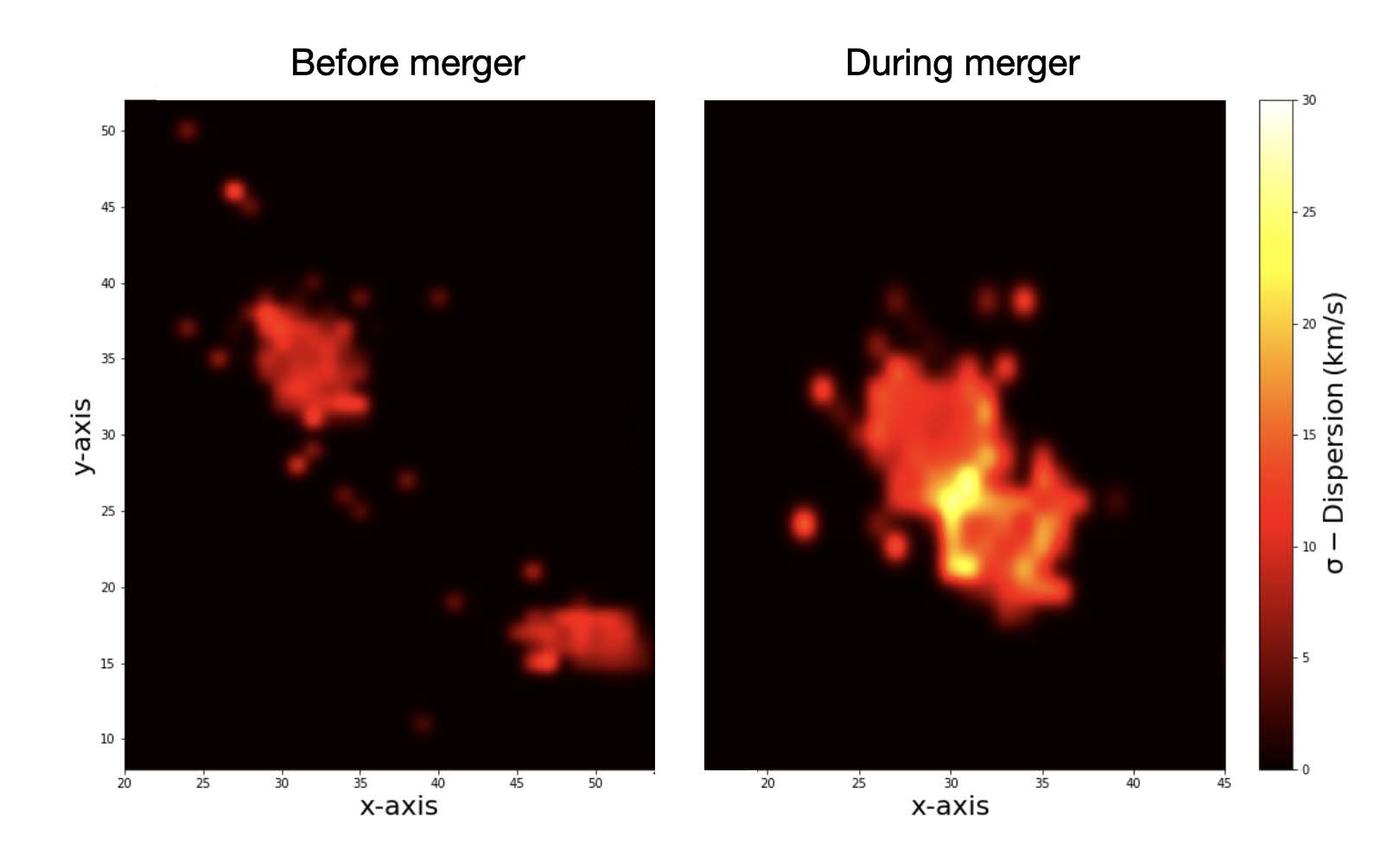
Velocity dispersion of a major merger of a dwarf and its satellite.


