The Gift of Numbers
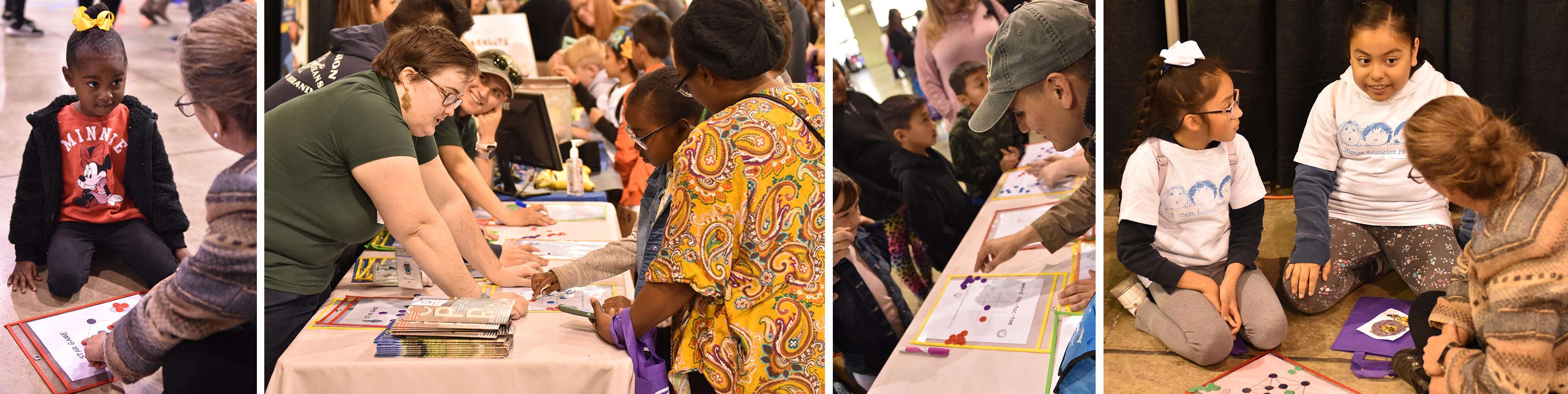
Over twenty years ago, a program was born at CPP called The Gift of Numbers. The concept was simple, take CPP students into elementary, middle, and high schools to teach math. The students are liberal studies and math majors who are pursuing teaching careers and they bring enthusiasm and innovative ideas that engage and excite students about learning math.
“Taking enthusiasm from math is unforgivable. When someone says, ‘I’m not a math person’ they got that from somewhere. Everyone is a math person,” said math Professor Greisy Winicki-Landman. She took over the program shortly after arriving at CPP 20 years ago, and still glows with enthusiasm when talking about it.
The program has two goals, first to provide a teaching experience, and second to make math more interesting and engaging. There are no calculators or worksheets. “They have to build, they have to discover, they have to do stuff,” Winicki-Landman said.
It provides early field experience for CPP students. Each instructor does it their own way and makes sure it’s related to the curriculum and fits with the age range and the California Mathematics Framework.
“Mathematics can be fun. Our students learn that these teaching techniques really work. They see the kid’s light up when things are done in a fun way,” said Winicki-Landman.
The program is so popular that they get more requests than they can accommodate. Currently the program is provided to Pomona Unified and Upland Unified school districts. How it works is that CPP students prepare age-specific learning materials and each has a station. Kids move from station to station, staying 5-10 minutes at each. Some schools give the kids extra credit. Sometimes the program is offered at night so parents can participate, allowing them to take the games and activities home to do with their kids.
Often, the teachers who are hosting the events incorporate these activities in their classrooms because they see how effective they can be.
Math major Gloria Diaz presented a mathematical game similar to Sudoku. Students are asked to fill a grid using cubes to build skyscrapers of different sizes in a row or column.
“What I learned from this experience is that sometimes you must let kids struggle a little. I found myself holding off on giving them hints. Most of them were able to get the answers and feel even better about themselves for getting it on their own,” Diaz said.
Diaz, who is bilingual, was able to engage with Spanish speaking parents. “The parents became more involved. I think that’s the ultimate goal of an educator, to involve everyone so that students have a great support system,” she said.
“This experience allows them to understand what it is to become a teacher,” Winicki-Landman said. “They may discover it’s not for them, or more often, it may confirm how much they love teaching.”


