In 2024 the CSU formed a committee to study and report on generative AI. That was followed by an AI initiative in early 2025. The CSU is working with Open AI to make ChatGPT Edu available to the 460,000 students and 63,000 faculty and staff. Information about that and other AI tools is available at the CSU’s AI Commons.
Many students, staff, and faculty already have experience with these tools. Faculty have long had concerns that students would use AI to get answers, bypassing the problem-solving component of their courses that is a critical part of learning.
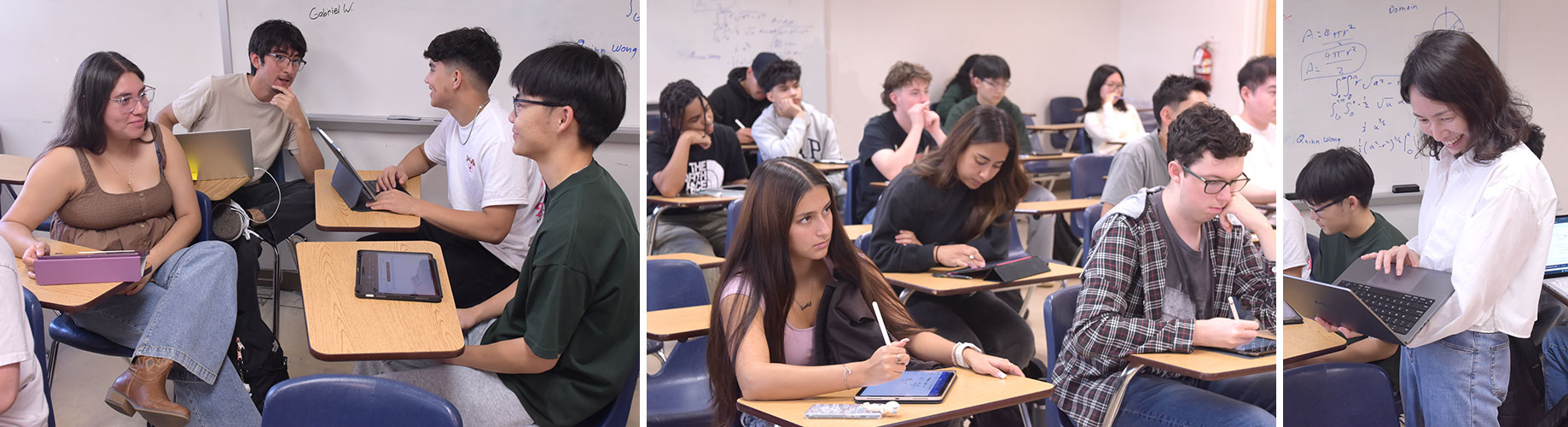
Such was the case in Assistant Professor Hyungkyoung Yoon’s math classes. “I saw students using their phones to take pictures of equations on the board and using AI to solve them.” Though initially disturbed by student’s use of AI, Yoon decided to embrace it. Her recently acquired grant from the Foundation for Community Colleges Learning Lab will allow her to do that more effectively.
She’s working with three other CPP faculty from the Mathematics and Statistics Department, and one from Florida State University on a project titled, Collaborative AI integration in STEM Education. The project seeks to demonstrate that AI integrated teaching strategies can support student success and help prepare students for careers in STEM or STEM education.
They’re incorporating the use of ChatGPT into their calculus I courses. In STEM fields, calculus is a gateway course, providing a necessary foundation for science, math, and engineering students.
The project focuses on improving task design, student-AI interaction, and critical thinking. Students collaborate on group projects in class. This integration of AI in teaching creates an active learning environment that engages students at a deeper level.
Student Danielle Cruz said, “we’re focusing on evaluating ChatGPT, checking it for errors and using it to find out what common mistakes students make in solving calculus problems.”
The use of AI-integrated tasks bridges the gap between students' desire for efficiency and faculty’s goal of fostering a deeper understanding of the material.
Engineering majors Christian Cortez and Sebastian Cruz, agreed that “ChatGPT is really good at creating study guides.” They use it for that and checking for errors in their work, not for cheating.
“When students use AI, some will use it productively. If they use it without thinking, just to get answers, I think the learning gap may become larger,” Yoon said. That’s what this project seeks to avoid.
A primary goal of the project is for students to have more critical and reflective engagement with generative AI instead of passive acceptance. Biology major Gaudalupe Hernandez shared, “I don’t really use AI in other classes. It’s not productive and I don’t want to get addicted to it.”
When asked about AI replacing workers, Yoon offered, “It can’t replace human creativity or critical thinking. For example, the calculator didn’t replace mathematicians. Generative AI is another tool we can use that may free up time for other tasks but we also need to verify its results.”
Yoon is looking to expand the use of AI in math teaching and is currently working on a grant to develop a calculus chatbot.


