X-ray Binaries Reveal Extremes of Physics
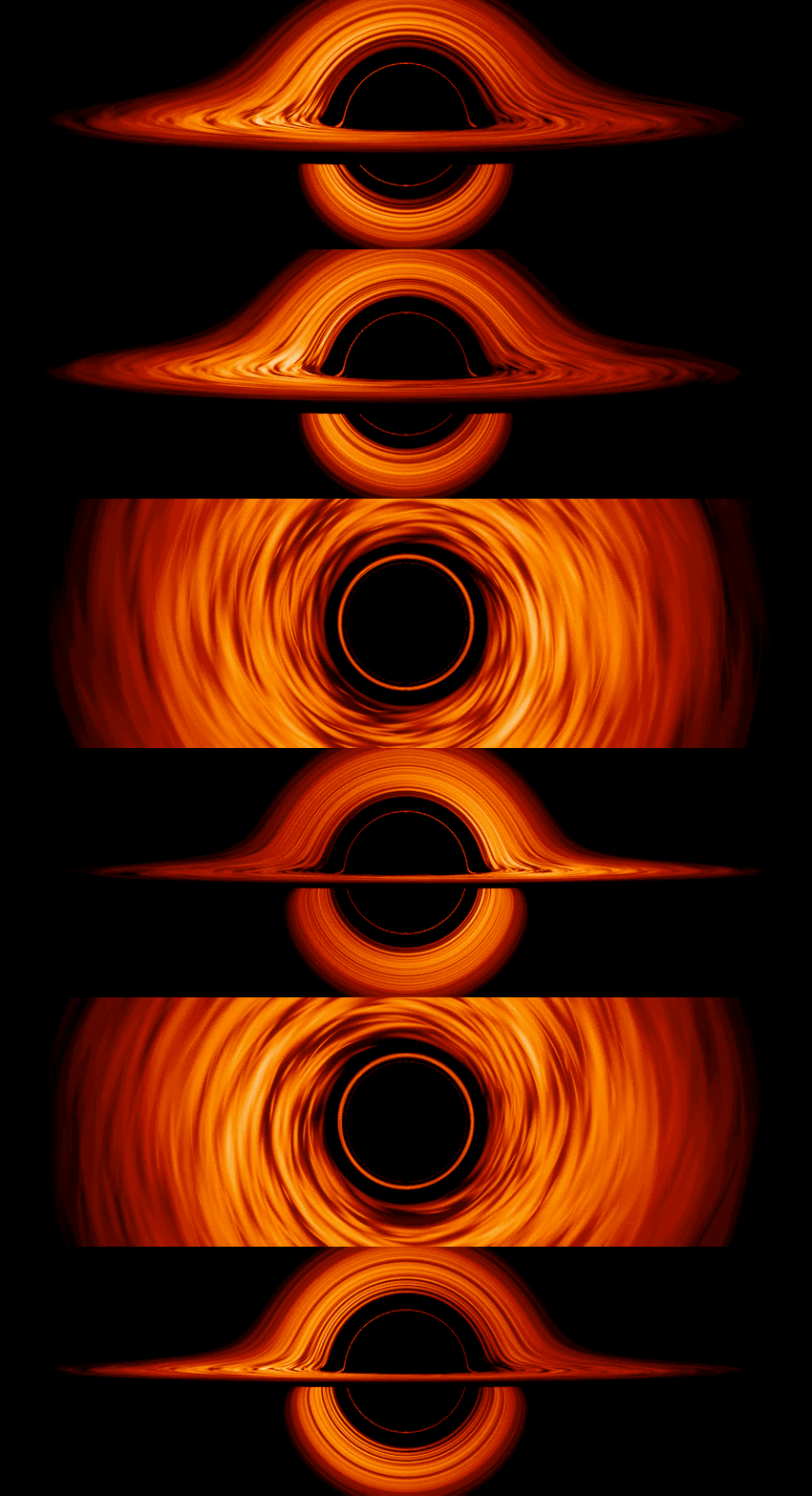 A 360-degree rotation of an Accretion Disk. The GIF pauses when the view is almost edge on. Credit: NASA’s Goddard Space Flight Center/Jeremy Schnittman
X-ray binaries are binary systems where a star and a black hole, or neutron star, are orbiting each other close enough that material from the star is pulled into the black hole or neutron star. This material forms an accretion disk and the rotating material of the disk glows hot and emits X-rays.
“Understanding these objects and how they interact with their environments is really cutting edge - at the forefront of physics research. This is where we can test physics at the extreme and it can only be done studying astrophysical objects. You can’t recreate it in a lab,” said Assistant Professor Breanna Binder.
Binder recalls taking her first astronomy course where her fascination with massive stars began. Her undergrad research led her to use data from the Chandra X-ray observatory. You can think of Chandra as Hubble with X-ray vision. Binder uses both in her research.
Chandra provides information about accretion disks and Hubble allows her to see the companion stars. Hubble provides evidence of the orbital motion of companion stars and the black hole’s mass can be determined by the nature of that orbit.
In 2019 her research team was able to determine the mass of a black hole called NGC 300 X-1. The companion star is a Wolf-Rayet (WR) star about 26 times the size of our sun. They found that the mass of that black hole was 17 times more massive than our sun.
“Despite being 17 times more massive than our Sun, the event horizon of the black hole is only about 100 km (about 60 miles) across.” The event horizon is the black part of the black hole. “It’s the ‘point of no return’ where gravity is so strong that nothing – not even light – can escape it,” Binder said.
Undergrad Janelle Sy (‘21, physics) co-authored the paper on NGC 300 X-1.
“I developed a passion for astrophysics after taking Observational Astronomy with Dr. Binder. The class exposed me to astrophysics research and taught me how to analyze astronomical data. I fell in love with making new discoveries and it felt extremely rewarding,” said Sy.
That research, conducted at CPP, paved the way for a recent grant from the Space Telescope Science Institute (NASA) to investigate the mass of IC 10 X-1. IC 10 is a small galaxy only 2.2 million light-years from us. It’s called the “starburst” galaxy because there’s a lot of star formation happening there. X-1 refers to the X-ray binary being the strongest source of X-rays in that galaxy.
Like NGC 300 X-1, IC 10 X-1 is a (WR) star orbiting a black hole. Those two X-ray binaries are the only two we’ve detected outside of our galaxy. IC 10 X-1 is believed to be the most massive stellar-mass black hole.
Binder is excited about studying physics in extreme conditions, something that the immense gravity of black holes provides. She points to the study or gravitational waves as especially important.
“Gravitational waves are ripples in space/time that Einstein predicted. But they’re so weak and small that we couldn’t detect them directly until about the last 10 years. The study of gravitational waves will be a Nobel Prize endeavor that revolutionizes our understanding of relativity and these black hole and neutron systems are the strongest emitters of gravitational waves,” she said.
In addition to her research, Binder also spearheaded the installation of a memorial to women in science in the north hallway that joins buildings eight and three. She saw that in the past sometimes women didn’t get credit for their accomplishments. Sometimes they weren’t allowed to hold positions that would enable them to get credit.
She spoke with Physics and Astronomy Chair Hector Mireles about her idea and he fully supported it. The wall includes such notables as astronomer Vera Rubin who discovered dark matter, and two-time Nobel Prize winner Marie Curie.
“I wanted to bring awareness to and acknowledge scientists whose names we should know and learn about their accomplishments. I wanted to add to the conversation about who does science,” Binder said.
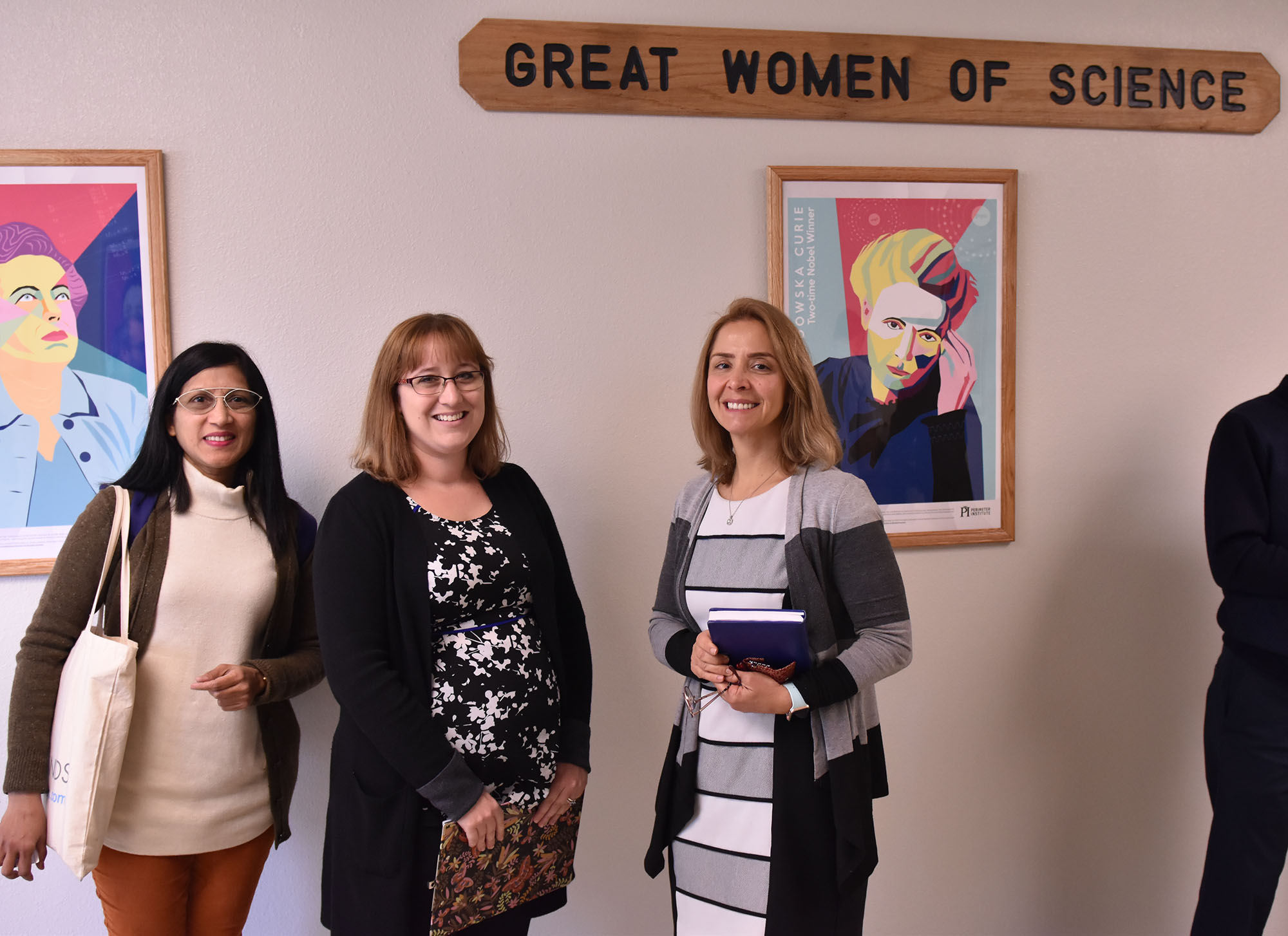
Some of our CPP great women of science (L-R) Rosie Nawpar, Breanna Binder, and Homeyra Sadaghiani pose for a photo during the dedication of the hallway commemorating great women of science.
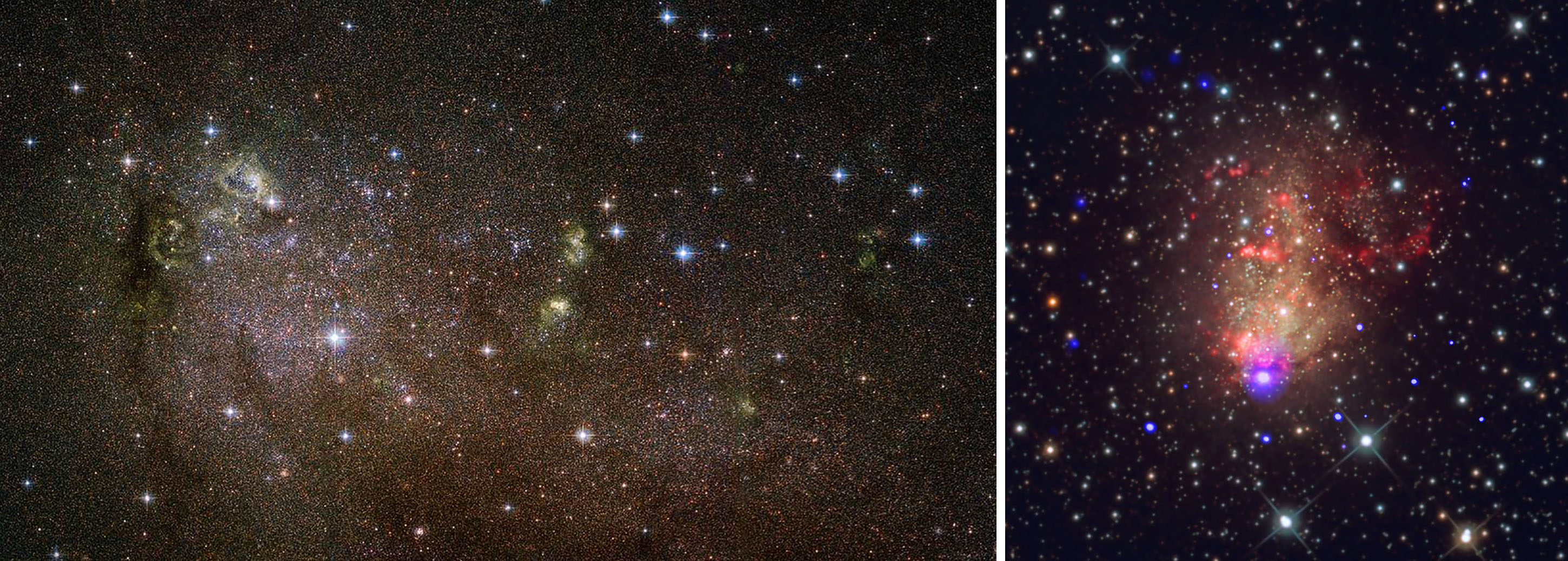
IC 10, Starburst Galaxy. Hubble image left, Chandra and an optical image combined right. Image credits: NASA, ESA and F. Bauer and X-ray: NASA/CXC/UMass Lowell/S. Laycock et al.; Optical: Bill Snyder Astrophotography


