Bats are the only mammal that flies and they’re found on every continent except Antarctica. They provide numerous ecosystem services such as pollination of wild bananas, avocados, and Agave. There are over 1,400 species of bats and one of them, the Mexican free-tailed bat (Tadarida brasiliensis) has been clocked at 99 mph, making it the fastest mammal on earth. Yuma Myotis (Myotis yumanensi) is the bat species you will most likely find on the CPP campus.
Assistant Professor Rachel Blakey first became interested in bats when she was working for an environmental firm in Australia. While working on a coal mine closure she was tasked with catching bats. “They really fascinated me. Seeing them call but not being able to hear what they were saying, I realized they had so many superpowers. It’s something that not everyone gets to see,” Blakey said.
Blakey joined the CPP Department of Biological Sciences in 2022 and her area of research interest is how humans co-exist with wildlife. Bats are one of the mammals she’s studying. Her students started a club called Bat Advocacy and Tracking Society (BATS). “Once I learned how essential bats are for ecosystems I wanted to help shift the way people see them,” said Julliete Martinez, who founded the club with four other students.
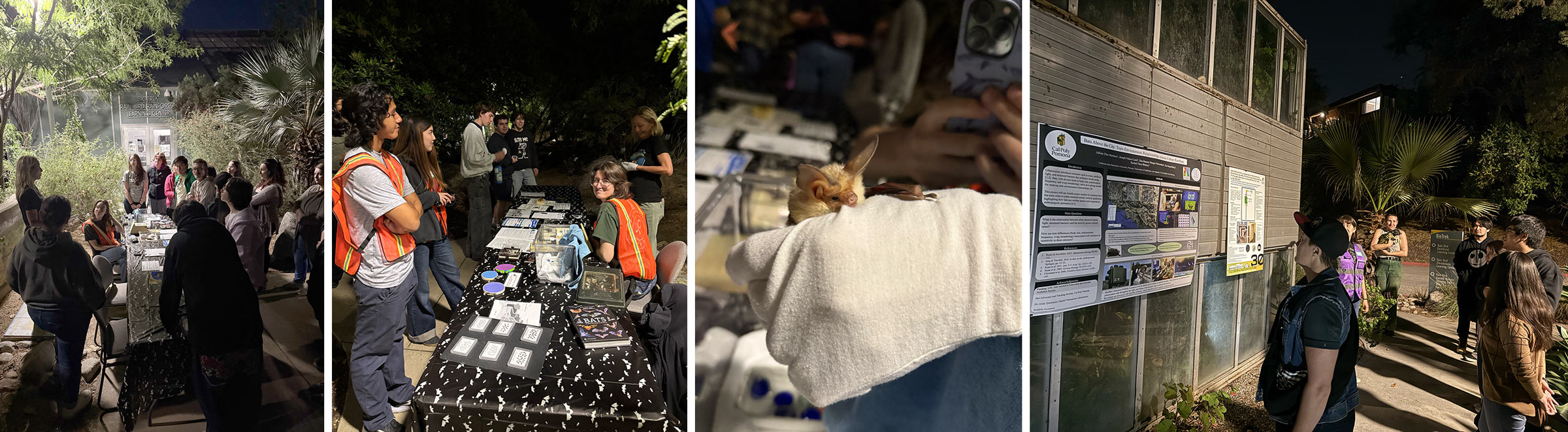
“Our club combines research, education, and outreach. On the research side we use acoustic detectors to monitor bat activity across campus and surrounding areas. For advocacy, we host public events like Bat Night to teach people about local bat species and their ecological importance,” Martinez said. “Bat nights occur in October, and in late spring, and we collaborate with conservation organizations, as well as the Lyle Center, to promote coexistence between humans and wildlife. We also involve students in data analysis and fieldwork, giving them hands-on scientific experience.”
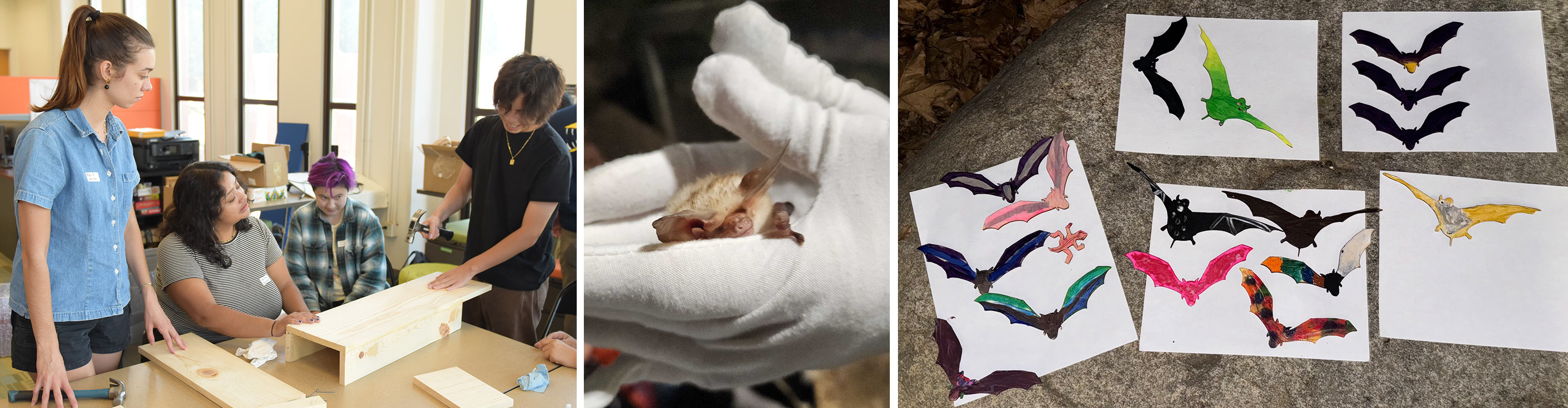
CPP Bat Night was the brainchild of Blakey and Professor Joy O'Keefe from University of Illinois, Urbana-Champaign.Guests get to see bats from CPP’s mammal collection as well as live bats brought to campus by LA Bat Rescue. Other activities include, arts and crafts, bat trivia, making bat-boxes, bat walks with detectors and a bat echolocation station.
Human hearing range is about 20 Hz to 20 kHz. The sounds that bats make when communicating with each other are sometimes audible to us; however, the sounds they make for echolocation are in the ultrasonic range from 33 kHz to over 200 kHz, outside of our hearing range.
The BATS club and Blakey’s researchers use heterodyne detectors that are capable of tuning in to specific frequencies. Different species use different frequencies. The detector converts ultrasonic sounds into audible ones. Prior to the event, students built bat boxes for the bats to roost and they plan to install them in various locations, making it easier to study the bats. There are bats roosting in some building locations on campus, Voorhis Ecological Reserve, and at Lyle Center. They also visit BioTrek’s pond to feed on insects.
Blakey and her students provide a vital service to the community, educating the community about urban wildlife and conservation. They have plans to do more outreach, taking their activities to local schools. They’ve also begun a collaboration with the Los Angeles Natural History Museum.
In the area of research, one of Blakey’s students is working in the Santa Clara River Valley. Under Blakey’s guidance, graduate student Sarah Heffelfinger is collaborating with Associate Professor Scordato who is PI on a project investigating the use of natural predators to reduce the need for pesticides.
“I'm looking to reveal seasonal dynamics of bat-mediated pest suppression,” Heffelfinger said. “To do this, I've collected bat poop or guano monthly from bridge-dwelling bats in the Santa Clara River Valley for an entire year. The samples will be sequenced using DNA metabarcoding. This will allow us to determine the specific insects that bats consume each month and compare diets between bats and different seasons to clarify how bats contribute to pest control and whether their diet aligns with key agricultural periods of vulnerability.”
After finishing her degree, Heffelfinger plans to work as a wildlife biologist.
Julliete Martinez, cofounder of BATS, plans to pursue her master’s degree and work in wildlife ecology, contributing to conservation and promoting coexistence in urban environments.