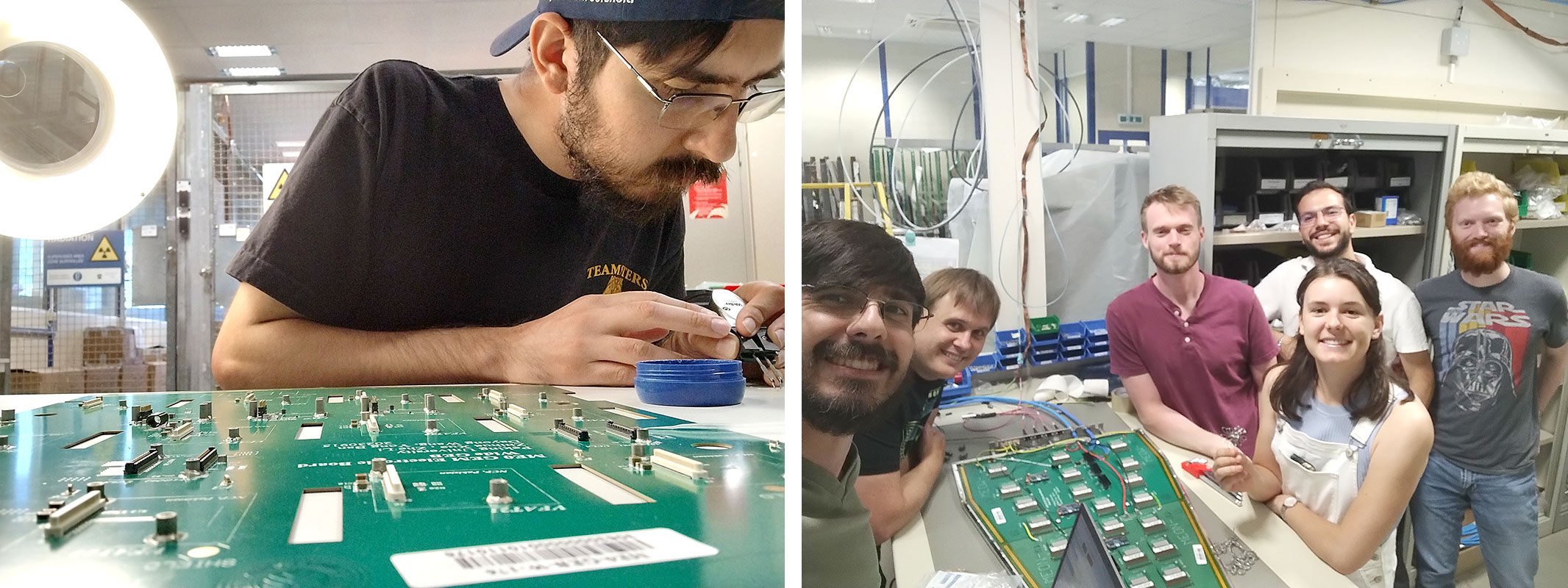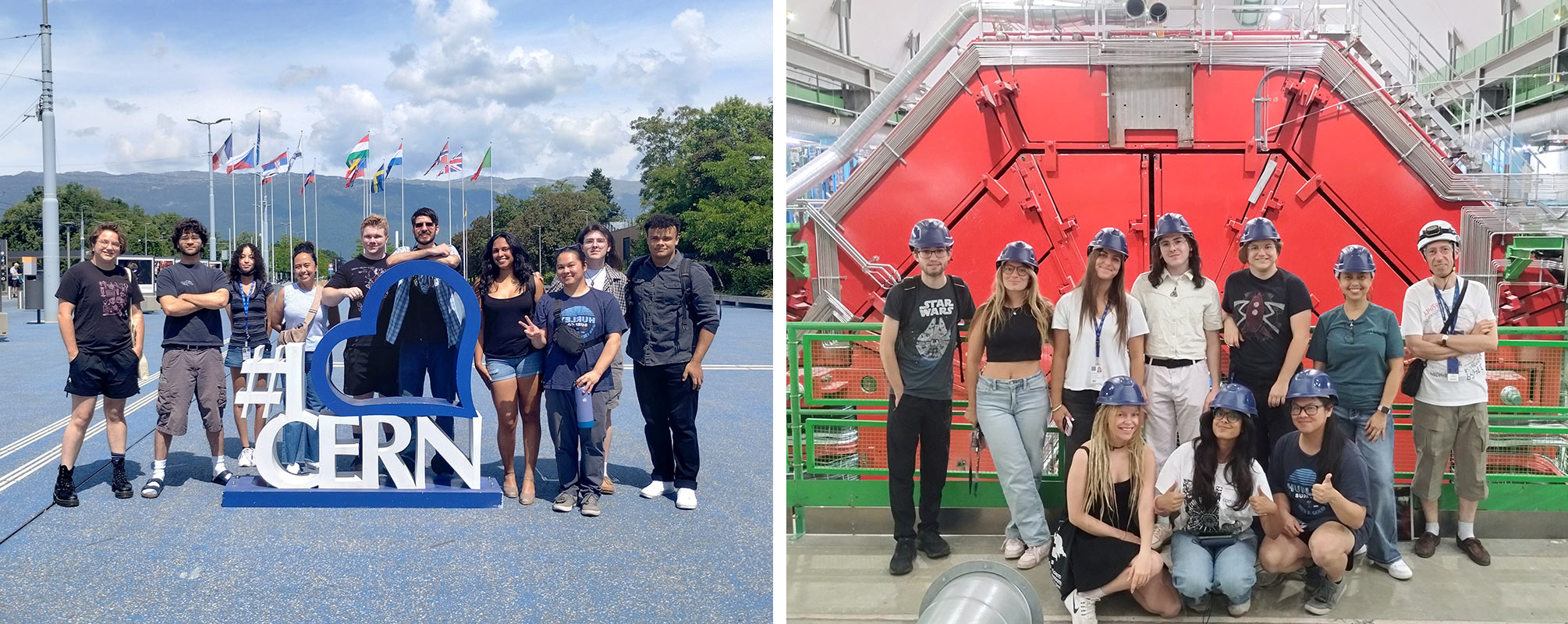
In June 2026 the Large Hadron Collider at CERN was shut down for maintenance and upgrades. When it reopens in 2030, it will include detectors that CPP students worked on and tested. Two of those students are Noah Dobson and Joshua Taylor from the Department of Physics and Astronomy.
“It was very cool. It’s the pinnacle of my academic and professional life so far. It was amazing to be surrounded by the heads of research in high energy physics,” said Joshua Taylor. His project was fabrication and testing strategies for Gas Electron Multipliers (GEMs). These detectors are part of the Compact Muon Solenoid (CMS). While at CERN, Taylor was mentored by Pieter Everaerts, particle physicist from University of Wisconsin-Madison.
CERN's GEMs stack layers of foil that have microscopic holes with a combination of argon gas and carbon dioxide which is ionized by incident ionizing particles. A potential difference applied to the foil creates an electric field, drawing electrons through the layers, multiplying their number in an avalanche of electrons. This creates a signal strong enough to determine the timing and path of a particle coming into contact with the GEM.
The CERN summer program was started with a grant at Fresno State. The opportunity begins with an introduction to particle physics course. That allows students to apply to the CERN program. If accepted, students take another course that teaches them about the tools and skills needed for particle physics research. For the trip to CERN, $6,000 of the cost per student comes from Fresno and in 2026 the CPP Department of Physics and Astronomy provided an additional $1,500 per student.
Taylor‘s interest in physics began in high school. “I wanted to dig deeper into the fundamental rules that govern the universe. With each science course I took I felt I was getting closer, but physics is about as fundamental as you can get.”
In addition to earning his bachelor’s degree in physics, he’s a parenting Bronco with one child and another on the way. He’s also been working full time since 2016. “My experience at CERN had a small bit of overlap with what I do at work in terms of working on the circuit boards,” Taylor shared. He works for the Air Quality Management District maintaining and repairing sensors.
Physics and Mathematics student Noah Dobson worked on machine learning (ML) to improve understanding of parton distribution functions which describe the probability of detecting a parton with a specific fraction of a hadron’s longitudinal momentum. They explained, “When we collide protons, we are colliding bundles of semi-free quarks and gluons, each carrying a fraction of the proton’s overall momentum. The ML model I produced takes detected events and attempts to classify them by what momentum fraction the two constituent particles that made up the event were carrying during collisions.”
“Another interesting result was that one of the models I trained was able to tag the initial states of the collisions, whose information should technically vanish according to theory, and we are currently in the process of verifying this result to make sure it's not a result of some bug, as it would have some rather large implications. The reason we care about all of this is that we want to reduce uncertainty in these so-called ‘parton distribution functions,’ which describe, given some energy resolution scale, the probability of any quark/gluons (collectively called partons) with a specific fraction “x” of a proton’s momentum.”
“This experience has significantly bolstered my career opportunities moving forward, as CERN is both world-renowned and rather difficult to get into, especially as an undergrad,” Dobson said.
Physics Professors Qing Ryan and Shohreh Abdolrahimi are PI and co-PI, respectively, on an NSF grant to evaluate the effectiveness of the physics courses offered in connection with the CERN program. Ryan said, “Providing students with the opportunity to conduct summer research at CERN is incredibly valuable. They can experience firsthand how international, large-scale physics research is carried out, work alongside scientists and students from around the world, and begin to see themselves as part of the broader scientific community. For many of our students, an experience like this would simply not be financially possible without external support. Funding is therefore essential not only for creating these opportunities, but also for ensuring that students have equitable access to transformative research experiences regardless of their financial circumstances.”
Current NSF funding runs through 2027 and additional CPP students will participate in the CERN summer research program in 2027. Faculty leaders are exploring ways to continue supporting students beyond the current NSF award. Those interested in supplementing the Department of Physics and Astronomy’s support for future student research opportunities may contact Bill Burrows: bdburrows@cpp.edu (909) 869-4160.
Other CPP Students who Conducted Research at CERN in Summer 2026
Aydin Haroon:
Construction and High-Voltage Testing of Particle Detectors for Experimental Physics (GDD Laboratory).
Osheen Gupta
CMS Muon Improved RPC Validation in CERN Gamma Irradiation Facility.
More about CERN
The CERN acronym comes from its original name (in French) Conseil Européen pour la Recherche Nucléaire, English translation: European Organization for Nuclear Research
The Large Hadron Collider is a 27-kilometer (17-mile) ring of superconducting magnets with particle accelerating structures that spans the border of France and Switzerland. It’s the largest and most powerful particle accelerator in the world. It’s underground with an average depth of 100 meters (330 feet).
Beams inside the LHC collide at four locations, each of which have particle detectors. The detectors are ATLAS, CMS, ALICE, and LHCb.
At CERN, the Higgs boson was discovered on July 4, 2012. The Higgs field, giving mass to elementary particles, was proposed in 1964. Higgs boson is a wave in the field. It’s the only known particle with zero spin.
CERN is the birthplace of the World Wide Web. British scientist Tim Berners-Lee developed the web in 1989 to enable the automated sharing of scientific information.