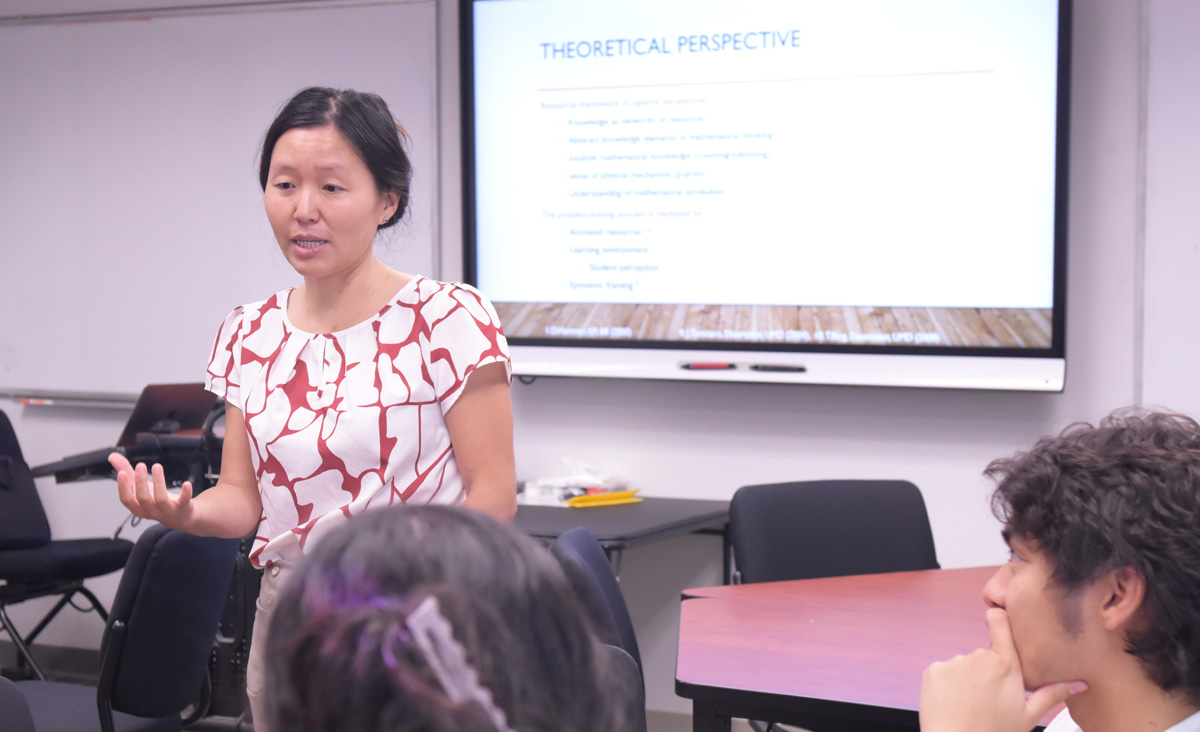
Although questions about teaching and learning date back centuries, physics education research (PER) developed as a distinct field in the 1970s, emphasizing discipline-specific investigations of how students understand physics concepts. Physics education research has played a prominent role in advancing evidence-based teaching practices, many of which have influenced instruction across STEM disciplines. PER is CPP physics Professor Qing Ryan’s specialty and a grant from the National Science Foundation (NSF) is allowing her, and collaborators at University of Colorado, Boulder, to study an important, but understudied, aspect of how students solve physics problems.
“Is teaching an art or a science? A great teacher has charisma and passion. That can’t be replicated. That’s the art part, but teaching is also a science. We want to find what we can reproduce, measure the outcomes, and observe the effects of different pedagogies,” Ryan said.
Much research has been done on how students use representations such as equations, graphs, and diagrams but little has been done on when and how students generate and use their own visual aids during the problem-solving process. This research will incorporate eye tracking enabled glasses that will record what students are drawing and how they’re using that visual information to solve problems and check their answers.
At CPP, Ryan will study the spontaneously generated representations from 30-40 students in a variety of physics contexts. The research team will craft physics problems on such topics such as mechanics, electromagnetism, quantum mechanics, etc.
Ryan’s prior research on physics problem solving emphasizes that solving a problem involves a series of decisions—what to represent, what to include, and how to proceed. These decisions vary across students, as representations that are helpful for one student may not be for another. So the goal is to study self-generated representations because a student may only externalize the representation to the extent that it’s helpful to them.
“Several studies have found that drawing diagrams can increase student success with solving physics problems. However, some of these studies also found that explicitly prompting students to generate diagrams does not guarantee improved performance, as students may produce representations without effectively using them in their reasoning” Ryan shared.
The data will be analyzed using the ACER framework. ACER stands for activation of the tool, construction of the model, execution of the mathematics, and reflection on the results. Ryan also plans to work with Associate Professor of computer science Ben Steichen who is experienced in using eye tracking and may assist with the machine learning component of analysis.
The research can help educators improve physics education and also has broader impact for STEM learning due to the fact that it will increase understanding of two foundational skills in STEM – problem solving and representational fluency.


