STARS Profiles
The Faculty Mentor Research Stars (STARS) recognizes faculty members who have engaged students seeking a Learning-by-Doing experience at Cal Poly Pomona. Each year we highlight the work of some of our STARS mentors. The following STARS Mentors were interviewed about what mentorship means to them.
Dr. Chantal van Esch
Associate Professor of Management & Human Resource
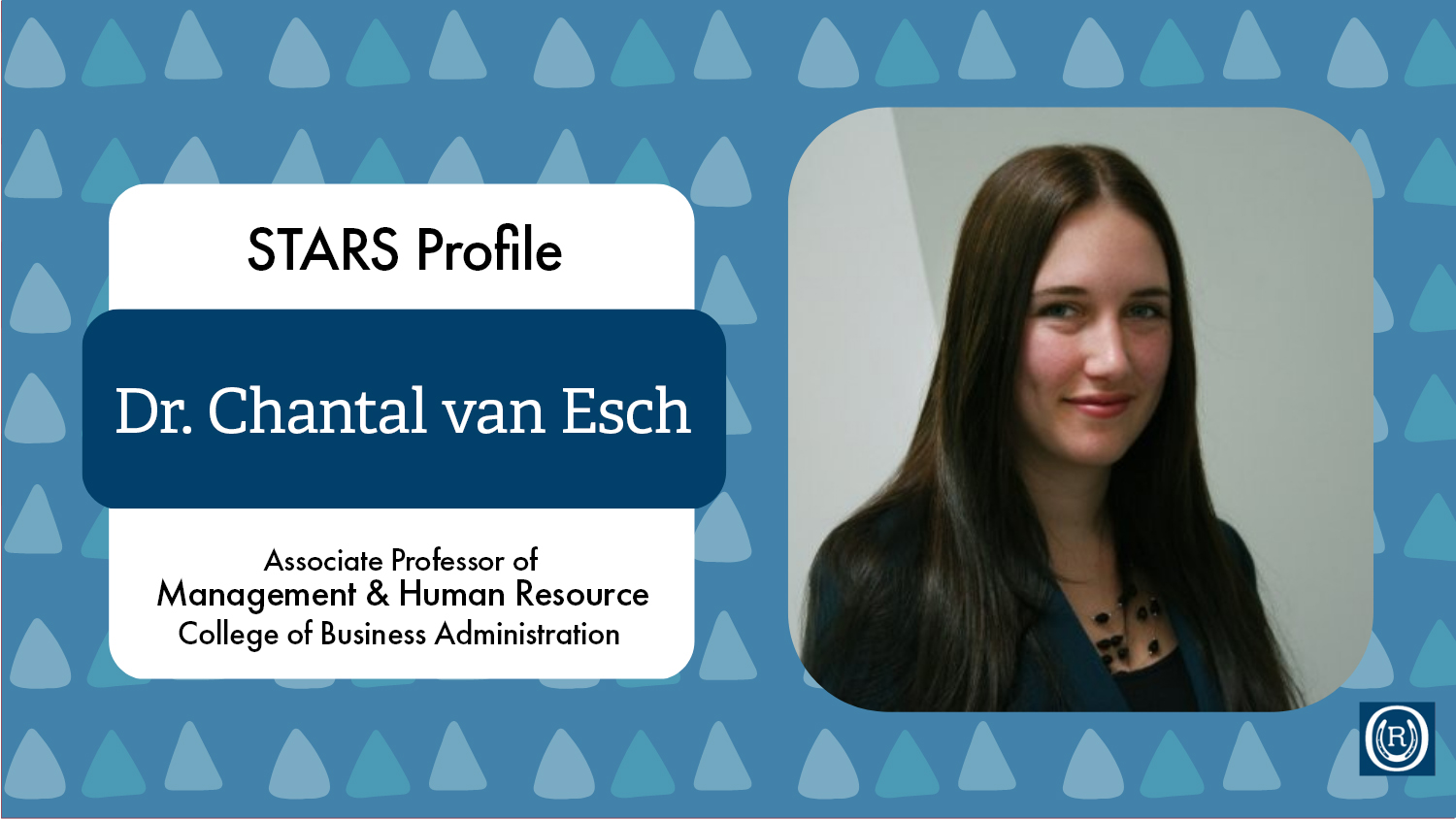
Department: Human Resources and Management
Began Working at CPP: 2017
“I believe in being the mentor that I would have wanted to have. I start from there and then get to know each student personally so that I can help them to achieve their goals.” - Dr. Chantal van Esch
Dr. Chantal van Esch first joined Cal Poly Pomona in 2017 and is currently an Associate Professor of Management. She became a Faculty Mentor STAR a couple of years ago when she was working with a student in the McNair scholars' program and numerous MHR (Management and Human Resources) students on their senior projects. She has mentored hundreds of students here at Cal Poly and states that mentoring is the most rewarding part of her job.
Dr. van Esch has an incredible academic background that has allowed her to have great research experience. She first received a B.A. in Psychology from Trinity University with minors in Business Administration and Speech Communication. She then received a Ph.D. in Organizational Behavior from Case Western Reserve University and completed a dissertation with the title of Humble Mentoring: Using a Relational Cultural Theory Lens to Understand Humility’s Impact on Mentoring Relationships and Career Outcomes.
She started doing research as an undergrad in psychology labs at Trinity University. Dr. van Esch was grateful that she was given the chance to work with numerous faculty members on many different types of projects and it helped improve the knowledge of her methodology and she developed organizational as well as communication skills. The most exciting thing about Dr. van Esch’s undergraduate research was the chance that she had to apply her research skills to a pro-bono consulting project that she did for the American Red Cross in San Antonio, Texas.
Dr. van Esch’s path to research was clear because she wanted to help students achieve their goals and in turn, wanted to develop herself to be better at that. She loves studying career development because it gives people insights into mentorship and teaching. Dr. van Esch has worked on countless projects while at CPP. Eight of her projects have been published in top-tier peer-reviewed journals that tackled many different research objectives. Her favorite projects are always the ones that she is currently working on because it gives her the ability to explore questions and develop new knowledge.
Dr. van Esch’s experiences have allowed her to be an incredible mentor. She highly believes in being the mentor that she always wanted to have. She starts her mentoring from the values that she wanted for her research and then gets to know each student personally in order to help them achieve their goals.
The most valuable thing that Dr. van Esch has learned from mentoring undergraduate students is that things do not always go as planned and that everyone needs flexibility and resiliency to achieve their goals. Dr. van Esch has seen her students grow from working with her through building their own self-confidence as they accomplish their research goals. The most important thing to her that she makes clear to all students is that she is their mentor and is there to support and help them navigate what their goals are.
“I love seeing my students build their own self-confidence as they accomplish their research goals. I make it clear to all students that I mentor that I am there to support their goals and sometimes that means helping them figure out what their goals are.” Dr. van Esch states when asked how she has seen her students grow throughout their research.
Mentorship has enriched research for Dr. van Esch is intertwined for her, she mentors' students that she teaches, and her research focuses on mentorship and other development relationships. She has developed mentorship programs for her students and working with students keeps everyone up to date on the latest research, and what is happening with companies right now. She brings this information back into the classroom. She attributes these factors to why she was honored with the Management and Organizational Behavior Teaching Society’s New Educator Award last year, 2021.
Dr. van Esch believes that research builds student success because students develop so many skills through participation in research. Students learn how to manage long and complicated projects, how to deal with setbacks, and how to ask questions. It enhances skills in written and oral communication. She takes pride in that because of research opportunities, her students have presented their research at international conferences and have published in peer-reviewed journals.
Dr. van Esch is currently working on a few research projects. One is being supported by the Diversity and Inclusion Initiative Grant sponsored by Wharton and Deloitte which looks at mentorship seeking during career shocks to understand if diverse groups must do more pre-work to get effective mentorship. Another one of her projects recently won the Management Education Division’s Junior Faculty Best Paper Award at the Academy of Management and looks at the impact of Covid on academic careers.
Her future plan is to continue doing research on career development with a specific focus on developmental relationships (such as mentorship), leadership development, academic careers, and management education.
What Dr. van Esch likes most about being a Faculty Mentor STAR is building relationships with her students. We have so many exceptional students here at CPP and she loves seeing them build their confidence and achieve their goals which makes everything rewarding. She has done outstanding work mentoring students and helping them achieve all their research goals.
The Office of Undergraduate Research would like to congratulate Dr. Chantal van Esch on her Faculty Mentor Research STAR (STARS) recognition. She has taken the responsibilities of a mentor to new heights as she reframes what it means to be a mentor to students. The OUR cannot wait to see more of Dr. Jellyman and her students’ research breakthroughs! Once again, congratulations on all your hard work.
Past STARS Profiles
Department: Biology
Began Working at CPP: Fall 2016
“Over time I have learned to modify my mentoring style for different students. I try to give confident students the space to work independently while maintaining an open-door policy so that I am available to help them as needed. If a student prefers more guidance, I try to schedule more regular meetings and check-ins so that they feel supported.” - Dr. Juanita Jellyman
Dr. Juanita Jellyman started at Cal Poly Pomona in Fall 2016 and is currently a professor in the Biological Sciences department. She has mentored countless students throughout her undergraduate and graduate career and is excited to now be mentoring her own graduate students. She just recently became recognized as a Faculty Mentor STAR in the Spring semester of 2022.
Dr. Jellyman’s academic career first began when she received a Bachelor of Science with Honors in Physiology (BSc Hons) from the University of Otago, in Dunedin, NZ, and then received a Doctor of Philosophy (PhD) in Physiology from the University of Cambridge, Cambridge, England. She worked as a postdoctoral research scientist at the University of California, San Diego, the University of Cambridge, and at Los Angeles Biomedical Research Institute at Harbor-UCLA Medical Center.
Dr. Jellyman first experienced research with her first project which looked at how ischemia-reperfusion injury damaged the microcirculation of the rat pancreas. She had the privilege of working with Dr. Anthony Wheatley (currently Chair of Physiology at NUI Galway) and a team of postdoctoral scientists and Ph.D. students in his lab. She was able to learn from a diverse group of scientists who taught her how to find and read peer-reviewed publications, how to collect and analyze data, how to communicate using scientific writing, and how to apply for graduate school programs. Learning these important skills solidified her love for research in the Biological Sciences field.
Dr. Jellyman has always been interested in maternal-fetal medicine and child health, and at first, wanted to pursue a career as a pediatrician. After thoroughly enjoying her undergraduate research experience, she sought out a lab that studied fetal physiology and then embarked on an academic career in research and teaching. These passions then relate to how she mentors her students. She maintains different mentoring styles for her different types of students. She likes to give more confident students more space to be independent and explore research on their own. She keeps an open-door policy so that she is available to help them as needed.
Dr. Jellyman has seen many students become more self-confident after working in the lab. She states that some students become more confident in their subject area knowledge, whereas others become more confident with certain animal handling or lab skills, and all students are more confident in their decisions to pursue further research training (or not).
Dr. Jellyman sees the impacts of research on student success through her countless mentorship experiences with students. She recounts this interaction with a student as one of the pivotal moments that shows the importance of research and how it builds student success.
“A few years ago, a student who had previously struggled in Bio 2350 Human Physiology started working in my lab. She asked me why I let her join the lab when she was "so bad at physiology". I explained to her that doing physiology research was not for people who were "good" at physiology. It was for anyone who wanted to learn MORE physiology.” - Dr. Jellyman
Dr. Jellyman’s current research project was recently funded by the Agricultural Research Institute (ARI) and will study cattle fly-repelling behavior. They are collaborating with researchers from the University of California, Riverside to place activity trackers on cattle and monitor specific behaviors the animals perform in response to biting flies.
Dr. Jellyman has loved her many interactions and mentorship experiences with students over the years. Her favorite part about being a Faculty Mentor STAR is interacting with the different students, getting to know all of them, and sharing their success stories. Dr. Jellyman has made a great impact on her students, and we are so honored to recognize her and celebrate her accomplishments.
The Office of Undergraduate Research would like to congratulate Dr. Juanita Jellyman on her Faculty Mentor Research STAR (STARS) recognition. She has taken the responsibilities of a mentor to new heights as she reframes what it means to be a mentor to students. The OUR cannot wait to see more of Dr. Jellyman and her students’ research breakthroughs! Once again, congratulations on all your hard work.
Department: Philosophy
Began Working at CPP: 2016
“Mentorship has inspired me to build more research opportunities into my own classes. And it's changed my own research because I've collaborated and am still collaborating with current and former students on various projects” - Dr. Alex Madva
Dr. Alex Madva began his journey at Cal Poly Pomona as a Visiting Assistant Professor in 2015-2016 and began as a tenure-track Assistant Professor in Fall 2016. He is currently an Associate Professor of Philosophy, the Director of the California Center for Ethics and Policy, and a Faculty Fellow here at the Office of Undergraduate Research. Dr. Madva became a Faculty Mentor Star in 2019 and so far, has mentored over 47 students on a total of 38 research projects!
Dr. Madva first began his academic career at Tufts University just outside of Boston, where he majored in Philosophy and English. He then pursued a Ph.D. at Columbia University. His academic beginnings were self-guided, and he was unsure about a lot of his first steps to getting into research. His interest in Philosophy grew when he began to realize that there were many problems still in the field of philosophy. Dr. Madva wanted to tackle the exclusionary nature that was still in place in this department and began to work towards research that was philosophically rich and stimulating but also relevant to understanding social injustice and social change. This specifically led to his research being based on a better understanding of the human mind, which led him to study the philosophy and science of implicit bias. This field has to do with the ways we sort people into categories based on things like their race and gender, and how those categories shape our thinking, feeling, and acting.
Research has shaped the way that Dr. Madva mentors students because of his past academic experiences. He found that during his undergraduate and graduate journey, he had a lot of very hands-off professors, and it taught him how not to advise. He appreciated the mentorship that he had, where he received concrete and applicable advice which allowed him to articulate the specific expectations. When he first started researching, he really benefited from professors who did not assume that he had already known what to do and helped him learn and improve his own research process. As a mentor, Dr. Madva has followed the lead of his past influential professors. He first began advising undergraduates when he was a postdoctoral fellow at UC-Berkeley in 2012 and has advised students pretty much every year since then.
“Our students never cease to amaze me. I learn over and over again that when students are passionate about what they're working on, when they get to pursue projects that they are genuinely interested in, they are willing to go above and beyond and produce incredible work that enhances our collective knowledge and can change the world.” Dr. Madva stated as the most valuable thing he has learned while mentoring students so far.
Mentorship has inspired Dr. Madva to build more research opportunities into his classes. It has also changed his own research because he has collaborated and is still collaborating with current and former students on various projects.
Research builds student success when students take ownership of their own projects and get to work on things that they are truly interested in. Dr. Madva believes that in turn, students are less likely to treat their education as something that is being imposed on them and something that they just must “get- through" to the next research stage. Dr. Madva loves seeing students become invested because it animates their passion for the pursuit of wisdom and for the betterment of their education. He believes that the education system should be shifted to focus on learn-by-doing and student-driven research. He states that the OUR has done its own research to demonstrate that students who engage in undergraduate research are more likely to graduate and thrive in their undergraduate careers. Dr. Madva notes that these studies are incredibly important, but it's also true that for those mentors who have mentored undergraduate students, it's often just *obvious* how much of a difference it makes to anyone who's paying attention.
Dr. Madva’s current research is that he is now co-writing a book on social change with two friends, Michael Brownstein, and Daniel Kelly. They are still trying to figure out a title for the book but tentatively we are calling it Structural Change: From Individuals to Institutions and Back. Dr. Madva states that many people nowadays argue that we need "big structural change" to fight challenges like racism, climate change, and misinformation. These folks often argue that too much of our thinking about these issues is focused on the individual level. That is, people are too focused on questions like "How can I avoid being prejudiced to other individuals I meet?" or "How can I reduce my personal carbon footprint?" This individual-level focus leads people to ignore bigger picture questions like racial segregation and the oil and gas industry. He wants these questions to help spark a new ethical change and bring awareness to these issues.
Dr. Alex Madva has been able to use the skills and experience he has gained from his previous mentors and student mentees to truly value diversity and differentiated approaches to research and mentoring. From his experiences in Philosophy and wanting to challenge the existing problems in his field, he has implemented that in his own work with students to provide them with the best practices he could possibly offer.
The Office of Undergraduate Research would like to congratulate Dr. Alex Madva on his Faculty Mentor Research STAR (STARS) recognition. He has taken the responsibilities of a mentor to new heights as he reframes what it means to be a mentor to students. The OUR cannot wait to see more of Dr. Madva and his students’ research breakthroughs! Once again, congratulations on all your hard work.
Department: Chemistry and Biochemistry
Began Working at CPP: 2015
“Research is really learn-by-doing and can teach so much about topics students are learning about in class. For chemistry, many students finally can understand and realize why they are learning certain things in their coursework... it encourages a student to learn more about an unknown topic.” - Dr. Chantal Stieber
Dr. Chantal Stieber joined Cal Poly Pomona in 2015 and is currently an Associate Professor of Inorganic Chemistry. She became a Faculty STAR the first year the program started, 2019. She has been mentoring students since her first semester here at Cal Poly Pomona and has worked on countless research projects with 56 students and counting!
Dr. Stieber began her academic career and received an undergraduate degree in Chemistry with a minor in Chinese from Whitman College in Walla Walla, WA. The following year, she taught English at the Xi'an Polytechnic University in China before beginning graduate school. For graduate work, Dr. Stieber started a Chemistry Ph.D. program at Cornell University (M.S.) and then transitioned with one of her research advisors to Princeton University (Ph.D.). Her postdoctoral studies were conducted at BASF in Germany and at Los Alamos National Laboratory.
Dr. Stieber didn’t begin undergraduate research until the summer after her junior year when she joined a biochemistry research lab at the Technical University in Berlin, Germany. She loved many of the research aspects but ultimately decided to switch paths and apply for Ph.D. programs and from there was able to learn about different areas within chemistry. Her academic coursework and research lead Dr. Stieber to a passion for organic and inorganic chemistry and it allowed her to focus on those areas in graduate school. Her goals related to research focused on positively influencing sustainability and the environment, and she then joined a group working on creating catalysts with more environmentally friendly metals than those currently in use. She currently still works in research like this today!
Her first research experiences resulted in countless positive research projects when she first started mentoring students in 2015 here at Cal Poly Pomona. She has an extraordinary number of ideas to bring to the table and loves learning the background behind her research. Her favorite student mentored projects are when the students can grow and change over the course of the project. Many students in her lab begin research projects before they have learned the topics in class, and it is so exciting to have them take those courses, help inspire “ah-ha” moments and create new research connections.
Dr. Stieber has learned many things throughout their research that have shaped the way that she mentors all the students in her lab. She wants to make expectations and resources clear to her students as well as include these components within her coursework. Dr. Stieber wants to meet all students where they are at, and their main mission in this research is to learn. She uses these tactics with her students because when she was doing research, she was also afraid to ask questions. She takes from her own experiences and encourages all her students to practice asking scientific questions in order to help them gain confidence.
“Many students start research in my group relatively early on in their undergraduate careers and can continue in the group until they graduate. It's neat to see how much students learn during this time and to witness them becoming true leaders in the lab and on campus.” Dr. Stieber stated when asked how she has seen her students grow throughout their research.
Dr. Stieber uses many of her research experiences when mentoring students and trying to create research-like experiences in the classroom. Some examples of this include having students in class conduct their own research projects and teaching about the different aspects of research such as presenting posters, using chemistry-related software, and reading literature. These different practices contribute to the goal of creating new opportunities for as many students as possible.
Dr. Stieber describes research related to student success as a learn-by-doing experience that teaches students topics that relate to in-class discussions. For her students in chemistry, it allows them to understand the real-life applications and why they learn certain things in their coursework. Research problems foster student excitement and encourage them to learn about new and unknown topics. Dr. Stieber hopes that her students use these real-life findings and apply them to their career prospects to help them succeed in their future goals.
Dr. Stieber has many current research projects, but one big area of research in her group is creating new catalysts using Earth-abundant metals to reduce pollutants such as nitrous oxide and nitric oxide. This involves synthesis work to make new complexes, reactivity studies to test catalysts, and spectroscopy and computations to understand behavior. Her future goals involve trying to use nitrous oxide and nitric oxide as chemical feedstocks to make useful molecules such as pharmaceuticals.
What Dr. Stieber likes best about being a Faculty Mentor STAR is that she loves having the opportunity to work with students and having them learn and grow. She has done incredible work to ensure the success of her many students and has allowed them to push the boundaries within the field of Chemistry.
The Office of Undergraduate Research would like to congratulate Dr. Chantal Stieber on her Faculty Mentor Research STAR (STARS) recognition. She has taken the responsibilities of a mentor to new heights as she reframes what it means to be a mentor to students. The OUR cannot wait to see more of Dr. Stieber and her students’ research breakthroughs! Once again, congratulations on all your hard work.
Department: Physics and Astronomy
Began working at CPP: 2018
“Research and teaching are not exclusive. The Faculty Mentor Research Stars program celebrates that and shows that the learning that happens in a research group is just as valuable as the learning that happens in the classroom.” -Breanna Binder
Dr. Breanna Binder joined Cal Poly Pomona in September 2016 as a postdoc, and in August 2018, she officially became a professor in the Department of Physics and Astronomy. From her time as a PhD student until now, Dr. Binder has grown a deep passion and interest in black holes. They became the focus of her research, studying and finding new information with her students that can be contributed to the continuing study of the galaxy and its components. At the end of her first year as a faculty member in 2019, Dr. Binder became a Faculty Mentor Research Star (STARS), having mentored six students who have now graduated. She is currently mentoring two students who are working on their own research.
Dr. Binder had an early start in her academics and research. While in high school, Dr. Binder began to take classes at Mount San Antonio Community College (Mt. SAC), and later in her junior and senior years of high school, became a tutor and teaching assistant. After graduating high school, Dr. Binder attended UC San Diego for her undergrad before going to the University of Washington to pursue her PhD. However, she became mesmerized by research during the first year of her undergrad while working at Carnegie Observatories. It was here that Dr. Binder was able to experience research being used in its purest form and most important purpose, which is as a tool to inform and educate.
Furthermore, her fascination by how math and physics could be applied to astronomical objects opened the door of astronomy for Dr. Binder. When she took introductory astronomy at Mt. SAC, Dr. Binder stated that she found herself most interested in massive stars, their evolution, and how they turn into black holes. She was fortunate enough to work on a research project at the Carnegie Observatories during her time there and was able to study supermassive black holes. Afterwards, Dr. Binder continued working on various research projects throughout her undergraduate career, presented at major professional conferences, and wrote her own first-author paper all before beginning her grad school career.
Throughout her postdoc career at the University of Washington, Dr. Binder began mentoring junior researchers and continued this when she arrived at Cal Poly Pomona. After some time spent mentoring CPP students, Dr. Binder was deemed a Faculty Mentor Research Star (STARS) in 2019 for all her contributions to student research scholars. From mentoring these students, Dr. Binder discovered that the students were not the only ones who had learned something by working together. She believes that mentoring undergraduates is a huge responsibility that goes beyond helping them debug code or make plots.
“I've learned a lot about meeting students where they're at, and tailoring research projects to a student's specific skill set to maximize their chances of success,” Dr. Binder stated when asked how her experiences have influenced her mentoring style.
Moreover, to be a mentor, Dr. Binder says you need to be able to aid your mentees in taking the next step in an academic career, such as getting into grad school. She emphasized that students need interesting scientific results to talk about, a network of professionals to advocate for them, and for these professionals to help spread the students’ names out into the community. Dr. Binder’s objective is not only to have then learn about science, but to fully immerse themselves in their work and become a true scientist.
“I always strive to connect my research and my classes in a way that students can relate to. Science is not a static set of knowledge in a textbook - it's a continuously evolving enterprise that students can make a meaningful contribution to. I want my students to see the development of science and the frontiers of modern research just as much as I want them to practice working out problems,” stated Dr. Binder.
Dr. Binder believes the reason research is crucial to students is because it builds their success as a whole. According to Dr. Binder, research provides a connection between the students' classwork and the "real world" of scientific research. Through research, they can actively use their studies and apply it to their daily lives. Dr. Binder also noted that students are more likely to stick with a difficult homework assignment when they can see the direct relevance between what they learn in class and how that knowledge will be used in their scientific careers. Nonetheless, these skills do not come overnight but must be taught and learned, and Dr. Binder has made that her target as a mentor. She has seen these students begin research unconfident in their skills and has helped them break through that barrier to blossom them into assured scholars who have gone on to write codes effortlessly, presented their work at a national conference, and some have even contributed to written papers that have been published in peer-reviewed journals.
Since her time at CPP, Dr. Binder has worked on numerous research projects. She mentioned that her favorite project involved measuring the mass of a black hole in a "nearby" galaxy ("only" 6.5 million light years away). She has been studying this object for a long time; just after finishing her PhD, she pointed out a technical flaw in the previous mass estimates of the black hole. In addition, after becoming a faculty member here at Cal Poly Pomona, she obtained new observations with the Hubble Space Telescope and Chandra X-ray Observatory (two of NASA's flagship "Great Observatories"). Dr. Binder was able to work on this project with one of her physics students, Janelle Sy, who just graduated and is now heading to New York University as a grad student in the fall.
Dr. Binder’s current research project focuses on the connection between star formation in a galaxy and the massive star and black hole population that results from those star-forming events. She mentioned that some of her undergraduate mentees will also be working on this project with her.
To become a Faculty Mentor Research Star, one must not only be knowledgeable within their field to help guide their students through their academic pursuits, but they must also help develop students as individuals in academia and the world—and Dr. Breanna Binder did just that. Her passion for research, mentoring, and black holes has turned into something incredible for Dr. Binder as she expands her research and mentors the next generation of students at Cal Poly Pomona.
The Office of Undergraduate Research would like to congratulate Dr. Breanna Binder for her Faculty Mentor Research STAR (STARS) recognition. She has taken the responsibilities of a mentor to new heights as she reframes what it means to be a mentor to students. The OUR cannot wait to see more of her and her students’ research breakthroughs! Once again, congratulations on all your hard work.
Department: Computer Information Systems
Began working at CPP: 2011
“The thing I like best about being a mentor and specifically, a Faculty Mentor Research Star, is getting to know so many excellent student researchers and growing with them!” – Sonya Zhang
Dr. Sonya Zhang joined the Cal Poly Pomona’s College of Business Administration’s Computer Information Systems Department in 2011. Since her time here, she has mentored and helped guide 20+ students on average each year on their research projects, while also providing them with a support system with intentions to help them grow as a research scholar, student, and citizen. Through her active and important participation and contributions to Cal Poly Pomona’s research community and its students, Dr. Zhang was awarded recognition for her efforts and became a Faculty Mentor Star (STARS) in Spring 2019.
Having a very extensive academic background, Dr. Zhang attended a total of four universities. She received her Bachelor of Science in International Economics and Trade at Guangdong University of Foreign Studies in Guangzhou, China, and afterwards began her journey to pursuing higher education in the U.S. Her next educational journey led her to Illinois State University in Normal, Illinois, where she completed both a Master of Science in Computer Science and her Master of Business Administration, and it was here where she not only found the path that led her into her dream field of work, but also where her interest in research began.
During her time at Illinois State University, Dr. Zhang’s favorite course in her MBA was Management Information Systems (MIS). She mentioned that her professor made her learn HTML and use it to create a website about various MIS topics (eCommerce, networking, etc.). That experience fueled her passion for applying computer technology in business, and furthermore made her realize that this was the area that she wanted to pursue academically. This curiosity led her to ask more questions and gave her more determination to learn more!
Like many students, Dr. Zhang began by becoming a research assistant of one of her professors. Her primary responsibility was to find news and articles online about the insurance industry. She would scan through hundreds of articles every day and summarize 20-30 of them, sending them to her professor who would later only choose a few from the pool of findings she had compiled. However, from this, she learned an important foundational skill of research, which is how to find good articles, scan for the important elements, and then summarize them for later use.
After completing both of her Masters’ degrees, Dr. Zhang wanted to continue her learning and expertise, going on to complete her Ph.D. in Information Systems and Technology at the Claremont Graduate University, in Claremont, California. With her PhD in hand, her journey led her to officially becoming a Cal Poly Pomona professor.
Since beginning to teach at Cal Poly Pomona, Dr. Zhang has worked on numerous projects. She has published 12 journal articles, 19 conference proceeding papers,1 book chapter, and 1book from her research. One of her favorite projects was the book The Smarter Startup that she published with Pearson Education, and which is available on Amazon and Barnes & Noble bookstores! Another one of her favorite projects that she mentioned was a presentation and book signing at the well-known SXSW conference in Austin. Furthermore, Dr. Zhang also developed a new course based on the book. Her current research projects are relevant to data analytics using machine learning. This project entails revising a manuscript that has been conditionally accepted by a journal and another manuscript that she plans to submit to a journal. Both studies focus on recommender systems for online consumer reviews.
Fast forward to 2013, two years after her initial start year at Cal Poly Pomona, Dr. Zhang began mentoring students herself. One of her students showed interest in doing research in mobile app development, and Dr. Zhang was excited to help this student conduct their research. Since then, each year she has advised and mentored 20+ Cal Poly Pomona students, and worked closely and directly with 10+ students, including Early Career Research Assistant, Kellogg Honor students, senior project teams, and other software development teams. After six years of mentoring students, Dr. Zhang received the Faculty Mentor Research Stars (STARS) Recognition in Spring 2019.
Dr. Zhang is also a huge advocate of making herself as a mentor, and research all together, a comfortable topic, in hopes to encourage more students to participate in it. During her course orientations, Dr. Zhang discusses her own research projects, as well as hosting different research-based workshops at student club meetings. She encourages students to reach out to her if they are interested in doing research together, or just simply have any research related questions.. Dr. Zhang additionally volunteers as a mentor for the Kellogg Honor Students for their capstone project, which is a graduation requirement. Working with more and more student research began a trickle effect that helped with spreading the words about Dr. Zhang’s research projects. Her students would tell their friends or student club members and they would come up to her and ask to join her research projects, which is one of the major goals she had as a mentor----to get students involved in research in any which way possible!
“The most valuable thing I have learned from mentoring my undergrad students is their amazing ability in self-learning and self-discipline,” said Dr. Zhang.
Seeing her undergraduate students grow from their experiences in research, Dr. Zhang has also been able to do some growing as a mentor and professor as well. Having collaborated on many research projects, and publishing papers with her students, Dr. Zhang wanted to incorporate that into her classroom, where every student can get a little experience in research, not just those working on projects outside of class. She has brought these research projects into her classroom by integrating various class activities including lectures, discussions, case studies, and group projects with research for her students. Her specific way of mentoring and teaching has brought success to many of her students. She stated that many of her students got their first job at companies like: JPL, Microsoft, Disney, Warner Brothers, Cigna, because they were impressed by the complex research projects they had conducted with Dr. Zhang. Publications, in addition to recommendation letters, have helped another two of her students get accepted into prestigious doctoral programs and multiple others into top master's programs. Dr. Zhang has made it her top priority to push her students forward with encouragement and help them excel in their field!
From creating a safe space for students to explore research at their own pace and comfortability, to helping them develop and conduct research projects, to helping students evolve professionally, Dr. Zhang has demonstrated what it means to be Faculty Mentor Research Stars (STARS)! Dr. Zhang has truly made an impact on her students and Cal Poly Pomona as a whole.
The Office of Undergraduate Research would like to congratulate Dr. Sonya Zhang for her Faculty Mentor Research STAR (STARS) recognition. Her passion for student success and research involvement is remarkable. Congratulations once again, and we cannot wait for many more student projects and success stories to come.
Department: Biological Sciences
Began working at CPP: 2006
“All the knowledge I have is useless unless I can pass it on to someone else.” – Ángel Valdés
In 2006, Dr. Ángel Valdés began his teaching journey at Cal Poly Pomona as a lecturer, becoming a tenure-track assistant professor in the Biological Sciences Department in 2007. He has taken on the role of a mentor, demonstrating the embodiment of a true student supporter and a curious researcher with a passion for sea slugs. Since his start at CPP and becoming a Faculty Mentor Star (STARS) in 2019, Dr. Valdés has mentored 23 graduate students and 15 undergraduate students.
Dr. Valdés’ educational and research background is quite unique. He completed his undergraduate studies, as well as his PhD at the Universidad de Oviedo (the University of Oviedo) in Spain. Next, Dr. Valdés became a visiting curator at the Museum National d’Histoire Naturelle (National Museum of Natural History) located in Jardin des Plantes, Paris, for about a year. As time continued, he received a postdoctoral fellowship that allowed him to complete his three years of postdoc at the California Academy of Sciences in San Francisco. His journey then led him on a new path as he became the Curator of Mollusks at the Natural History Museum of Los Angeles County. Within this specific time frame, Dr. Valdés was also an adjunct professor at University of Southern California (USC) and the University of California, Los Angeles (UCLA). Fast forward to 2006 and Dr. Valdés joined Cal Poly Pomona, teaching one class before becoming a tenure-track in 2007.
With a large list of career explorations, there’s no question that Dr. Valdés is amongst those who ask questions and want to explore answers more deeply. His interest in research and investigation led him to complete about 80 or so research projects so far over the course of his academic career.
As a child, Dr. Valdés began to develop a massive interest in animals and plants and was very curious and eager to learn more. However, as he dived deeper, his curiosity led him to a newly found interest in marine animals. It was in high school where his small fondness grew into a passion when he found his first sea slug. Blown away and in awe by the complexity of this small creature and its beautiful colors, Dr. Valdés’ research interest began. He wanted to know and learn all that he could about sea slugs and, soon after, this interest followed him into college, and more specifically his lab research experience.
It was at the Museum in Los Angeles where Dr. Valdés first became a research mentor. He mentored a couple of students, but he did not have the possibility to work with his own graduate and undergraduate students. This was the main reason why he decided to come to Cal Poly Pomona and when he did, he began recruiting students right away.
In general, the students that Dr. Valdés mentors typically approach him searching for research opportunities and a mentor. Most of the mentees are students from CPP who have taken a class with him, but he has also mentored international students. Most of these international students have a growing fascination for sea slugs, just like Dr. Valdés, so it is only fitting to have them as his mentees. Dr. Valdés’ is also one of the few labs in the world focused so deeply on sea slugs.
Currently, Dr. Valdés is working on research that is focusing on a large collection of sea slug specimens from New Caledonia that he collected during the last couple of years. Before COVID-19, he also participated in two research expeditions to New Caledonia with former colleagues from Paris and brought a number of new species of sea slugs. His future plan is to work with his students to describe as many of these species as possible.
“Research builds confidence in the students and gives them focus and motivation to complete their studies and pursue careers in science or teaching,” says Dr. Valdés.
Throughout the 80 projects he has worked on since his time at CPP, he noted that some of his favorites have been the unraveling of the migration pathway of an invasive sea slug in the Mediterranean. Another favorite of his were projects that have aimed to discover new species, particularly in California. However, more importantly his favorite thing about being a research mentor is being able to work and interact with students from across the world and different backgrounds, seeing them succeed and passing on his knowledge to the next generation.
“I have seen them become confident speakers, productive scholars and great mentors to other students in the lab. I have now students who have faculty positions or are in highly competitive PhD programs. I am very proud of their achievements,” stated Dr. Valdés.
Dr. Ángel Valdés has been able to use the skills and experience he has gained studying and working in several countries to truly value diversity and differentiated approaches to research and mentoring. From his experiences and knowledge learned throughout the French, Spanish and American systems, he has implemented that in his own work with students to provide them with the best practices he could possibly offer.
The Office of Undergraduate Research would like to congratulate Dr. Ángel Valdés for his Faculty Mentor Research STAR (STARS) recognition. His eagerness and passion to teach and impact the students of the future with lasting knowledge is commendable. Congratulations on all your research successes, past, present and future.
Department: English and Modern Languages
Began working at CPP: 2019
“‘Rome wasn’t built in a day’ – research takes time and many, many steps. Conceptually speaking, research is asking and answering a question; methodically speaking, research is starting at point A, which after completion lets you move on to point B, point C, and so on and so forth. The process is exhilarating, and the end product is worth every step.” – Dr. Alyssa Kermad
Dr. Alyssa Kermad began working at CPP in the English and Modern Languages department in the fall of 2019. Being a part of Cal Poly Pomona’s Faculty Mentor Research Stars (STARS), she has demonstrated time and time again why she encapsulates the true meaning of being a research mentor. Dr. Kermad became a STARS mentor at the beginning of 2021 due to her successful mentoring of three CPP students thus far. She has positively represented the mentor-mentee relationship, while also working towards encouraging more students to seek out research opportunities and faculty members in their area of interest.
Dr. Kermad’s path to her specific field of research started when she was young. When she was in 5th grade, a teacher introduced her to the pen pal program, which was designed to connect people from around the world to each other. For $1, she was able to select a country, be sent the name and address of someone from that specific country, and the two pen pals would write letters to one another. Out of the five people she wrote to, there was one particular person that Dr. Kermad immediately connected with. Her pen pal from Japan immediately responded to Dr. Kermad’s initial letter, and from there on their letter communications became more constant.
Throughout those years, Dr. Kermad and her Japanese pen pal kindled an unbreakable friendship, visiting one another in their home countries. Ultimately, her pen pal decided to come to the U.S. to finish high school with her American best friend, and this is where Dr. Kermad’s love of language ignited. Dr. Kermad would see her pen pal studying in the early hours of the morning---not only studying her school materials, but her second language of English. This inspired Dr. Kermad to not only learn more languages, but to help people like her best friend learn other languages. From her growing interest and curiosity, Dr. Kermad began to study her pen pal’s native language of Japanese and was dedicated to learning how to read and write Katakana, Hiragana, and Kanji characters.
This passion for language continued to grow. Dr. Kermad later attended Allan Hancock College, where she took courses to learn French.
From there, she transferred to Cal Poly San Luis Obispo and completed her B.A. in English, along with minors in French and Linguistics. In addition, Dr. Kermad became certified in TESL and soon after completing her B.A., moved to France and taught English for two years. Later, she returned to the United States to pursue an M.A. in TESL at the University of Illinois, Urbana-Champaign. After completing her M.A., Dr. Kermad once again returned to France for two more years to teach English, before finally moving to Flagstaff, Arizona, to complete her Ph.D. in Applied Linguistics.
It was during her two times teaching in France where Dr. Kermad realized she wanted to pursue research in second language speech and pronunciation. She explained, “I found it fascinating that there was such great variability in pronunciation performance among learners, and I wanted to discover what accounted for that variability. This inspired my dissertation, which was on individual differences and pronunciation outcomes.”
During her time as a CPP professor, Dr. Kermad has had the opportunity to guide several research projects that have reflected her career and educational interest. One of her favorite CPP projects was an elicited speech act (e.g., requests, invitations, refusals, negotiations, apologies) on responses from native and non-native English speakers. Furthermore, in this specific project she provided a scenario, and the research participants provided a recording with a response that they would actually say in that situation. Dr. Kermad enjoyed hearing their responses and seeing the linguistic and prosodic patterns, and she has used these findings to further understand her field.
Dr. Kermad has been involved in multiple programs through the Office of Undergraduate Research, which lead to her mentoring three different students thus far. In her own classes and the independent studies she supervises, Dr. Kermad has also been able to mentor many other students who have approached her with interest in getting involved in research.
Dr. Kermad added, “Undergraduate students are bursting with different talents and abilities. When it comes to research, they simply need someone to help guide them in how those talents and abilities can be applied to asking and answering important questions in a methodical way. It is a true honor for me to get to be that person.”
Currently, Dr. Kermad and her research assistants are working on two new projects. The first focuses on the connection between speech acts and listeners’ perceptions of politeness. In this project, Dr. Kermad and her assistants perform quantitative speech analyses of prosody (prominence, pitch, and intonation) to describe different correlates between what makes speech sound polite and impolite. The implications of this study will ultimately inform pedagogy and guide teachers in this sort of instruction in English as a Second Language (ESL) classes.
The second research study that she is working on investigates the role of multilinguistic identities on speech patterns. Dr. Kermad explained that in an area like Southern California that is linguistically diverse, community members grow up being exposed to or speaking more than one language. Furthermore, she and her research team are working on how these community members identify with these languages, how this can affect their actual speech performance, and how they interact with others around them.
“My students see linguistic phenomena from different eyes, and their ideas have made me literally stop what I’m doing and completely change my thought process. I love that we are able to co-construct research questions, designs, methods, analyses, interpretations, and implications together,” Dr. Kermad described.
Working closely with students on projects like these keeps Dr. Kermad motivated to stay on top of current trends in the field. She believes that when students ask great questions, they bring up critical observations, address gaps in the literature, and encourage her to think about what she teaches and researches more critically. As a Faculty Mentor Research Star, Dr. Kermad shared that one thing she likes best is meeting students where they need to be met.
“Different students have different strengths in different areas. I need to meet them in the middle where they need that extra support and guidance. I live for witnessing the “aha” moments they have along the way,” Dr. Kermad mentioned.
Throughout her time mentoring, Dr. Kermad has not only been able to learn from and develop close relationships with her students, but she has also been able to get the experience of watching them grow into scholars. Dr. Kermad leaves room for self-development when mentoring her students, providing them with an opportunity to discover their own unique strengths and weaknesses, and use those discoveries to propel forward in their education and life.
Dr. Kermad concluded, “Student research is valuable for student success for so many reasons. First of all, it opens new doors for students to become very deeply engaged in their degree program, in their coursework, in their campus community, and in their community at large. Second, it allows students to see first-hand how we continue to advance our fields of inquiry, pushing the boundaries to new thought, innovation, and application. Third, while research pushes students to become more autonomous, it also provides plenty of opportunities for collaboration. And fourth, being engaged in research gives students an edge when they are applying for graduate programs, leadership positions, job opportunities, and more.”
The Office of Undergraduate Research would like to congratulate Dr. Alyssa Kermad for her Faculty Mentor Research STAR (STARS) recognition. The OUR admires her mission to provide students with the best mentoring possible, and her support for students to really seek personal growth throughout their research process. We look forward to the success of your future CPP mentees.
Department: Biological Sciences
Began working at CPP: 1994
“My experience here at Cal Poly Pomona is like a privilege for me. I come to school looking forward to teaching my next class or mentoring my research students. I don't view this as a job, but rather an honor and privilege that I thoroughly enjoy.”– Dr. Glenn Kageyama
In 1994, Dr. Glenn Kageyama's journey at Cal Poly Pomona began as he joined the Department of Biological Sciences and became a Professor of Neuroscience and Cell Biology. Over the years at CPP, Dr. Glenn Kageyama has mentored more than 100 students on their research journey, and he became a Faculty Mentor Star (STARS) in 2020.
There were many elements that contributed to Dr. Kageyama’s career-focus on the human brain and neuroscience. However, two specific events that occurred after he completed his undergraduate degree ultimately encouraged him to go to graduate school and expand his research interest. The first was the passing of a close friend's child, who had developed epilepsy and became very frightened about what was happening to him during his illness. The second event happened while he was working at White Mountain High Altitude Research Station, when two neuroanatomy students from UC Berkeley asked Dr. Kageyama if he could assist them with some neuroanatomy experiments. As an undergraduate, Dr. Kageyama was also curious and fascinated by the brain, but he was unfortunately not impressed with the way it was taught to him at the time. But through these two events, Dr. Kageyama was able to rekindle his interest in neuroscience, leading him to attend UC San Francisco (UCSF) Medical School to complete a PhD in Neuroanatomy.
After completing his PhD program at UCSF, Dr. Kageyama became an Adjunct Professor at the College of Medicine at UC Irvine and started mentoring students in their research. He has continued to mentor students after joining Cal Poly Pomona, working on seven major research projects and mentoring over 100 students since 1994.
Dr. Kageyama mentioned that the way he and students connect to work on a research project varies. Some students approach him with their own project, and he will provide advice and guidance to help them maneuver through the process. Other times, Dr. Kageyama will design projects for both individuals and groups of students, once again providing aid in every aspect of the research process. Dr. Kageyama also trains his more experienced research students to assist less experienced students, incorporating CPP’s “learn-by-doing” motto. He does this by providing online training modules that focus on standard safety in the laboratory, animal care procedures, and the best laboratory practices one can do.
After many years of mentoring students, Dr. Kageyama has developed several mentoring styles that help him provide personalized support to all students. His mentoring style heavily depends on where the students are within their research journeys. He has a range of students who come up with their own individual ideas and are ready to work on their own projects. Meanwhile, other students need more step-by-step assistance. Nonetheless, Dr. Kageyama works with his students at whatever level they are at, helping them mature and succeed in their work.
Mentoring students has rewarded Dr. Kageyama with a personal relationship with his mentees, which grows as he watches them develop into enthusiastic scholars and sees the satisfaction of their educational accomplishments. He receives great gratification when one of his mentees reaches a point in their research career when they are able to try new things on their own, such as developing their own unique techniques or building the confidence to test out their ideas. Furthermore, Dr. Kageyama believes that research builds student success because it challenges students to improve critical thinking, ask the right questions, and learn hands-on technical skills that a student cannot obtain through regular classroom instruction.
Dr. Kageyama stated: “I have seen students transform from being inexperienced, unconfident, timid novices to becoming well-poised, confident research technicians and communicators at undergraduate conferences. I point out areas where they need more focus, guide them through learning how to search for, read and understand scientific literature, and teach them to summarize the main points.”
Dr. Kageyama is currently working on two current research projects with student assistance. The first is the “Role of Environmental Enrichment in Modulation of Interneuron Activity in the Hippocampus, A Possible Mechanism for Cognitive Resistance to Neurodegeneration.” The second is “Neuroprotective Role of Hypoxia Adaptation in Dementia Resistant Alzheimer's Disease.” He also has future plans to work on a research project that focuses on rats exposed to environment enrichment and the role in which hypoxic adaptation plays in this case.
Throughout his years at Cal Poly Pomona in the Biological Sciences department, Dr. Glenn Kageyama has impacted both undergraduate and graduate students, helping them develop into researchers and scholars with a passion for digging deeper into their work. From all his years mentoring CPP students, he stated it is still a privilege to teach and mentor students each day, witnessing their rising potential.
“What I have learned is that we have a lot of very intelligent students at Cal Poly Pomona who have a lot of potential as future researchers, pre-professional health specialists, or engineers. They each have the potential of making important contributions to society,” said Dr. Kageyama.
The Office of Undergraduate Research would like to congratulate Dr. Glenn Kageyama for his Faculty Mentor Research Star (STARS) recognition. Dr. Kageyama has dedicated his years at CPP to help students develop personal confidence and knowledge to help propel them forward in their educational journey.
Department: Philosophy
Began working at CPP: 2015
“There’s an internal, intellectual back-and-forth that happens in philosophy when you’re working out an argument, or solving a puzzle or problem. This back-and-forth means that sometimes the ideas inspire you, and sometimes they disappoint. But the goal is to grow and change, openly and honestly, in trying to get it right.” – Dr. Katherine Gasdaglis
Dr. Katherine Gasdaglis, one of Cal Poly Pomona’s very own Faculty Mentor Stars (STARS), has been an advisor for over 90 undergraduate theses and has guided 13 of these projects towards earning a Research Distinction. She is a philosophy professor and joined the CPP Philosophy Department back in 2015. She completed her undergraduate work at the University of Notre Dame and later received her PhD from Columbia University.
The path that led Dr. Gasdaglis into her field and research was actually influenced by two significantly different areas of philosophy: Immanuel Kant and feminist philosophy. Dr. Gasdaglis studied Kant, incorporating his theoretical philosophy into her undergraduate thesis.
As she moved on to graduate school, Dr. Gasdaglis continued to work on Kant’s theoretical philosophy while she became a teacher’s assistant for a Women and Gender Studies course and a Feminism and Philosophy course. From these two opportunities, Dr. Gasdaglis was exposed to the concept of intersectionality and to a feminist critique of the views of several major figures in the history of western philosophy. However, Dr. Gasdaglis found that she could not state a clear and sufficient definition of intersectionality, which is why she spent the next several years researching how intersectionality applies to a variety of fields and how to define it in the most inclusive way possible. Furthermore, it was during those years of research that Dr. Gasdaglis read a piece of literature on Kant’s philosophy of science and realized that she could connect these two concepts together. This research continues on into her current teaching career.
It was the fall semester of 2016 when Dr. Gasdaglis first became a research mentor for the Philosophy Department. While at CPP, Dr. Gasdaglis has been an advisor for over 90 undergraduate theses as an instructor of record for the Philosophy Department’s Senior Seminar course. She has guided 13 of these projects towards earning a CPP Research Distinction. During the 2018-2019 academic year, Dr. Gasdaglis received awards for both Tier 1 and 2 of the Faculty Mentor Research Stars program and was recently awarded Tier 3 in the 2019-2020 academic year.
At Cal Poly Pomona, Dr. Gasdaglis has participated in several of her own projects and was also a coauthor on a paper that defends a particular way of understanding, or modeling, intersectionality, that draws on Kant’s notion of a “regulative ideal.” Her most recent work focuses on answering a certain objection raised to intersectionality, specifically whether the method is capable of throwing light on the oppression men of color have faced, as men. In addition to this, she is also working on another paper related to this research and aims to raise intersectional objections to the model of identity choice, or prioritization. Dr. Gasdaglis mentioned that she already has a future project in mind, although it’s not related to her typical interest areas. She wants to discuss the importance of voting and how voting may affect people, both individually and nationally.
Dr. Gasdaglis mentioned that her experiences with research have influenced her mentoring style. She noted that students respond differently to different advising styles and that many students respond positively to having a lot of clear structure to the thesis-writing process.
She states, “The structure helps them to synthesize more information than they are used to working with, gives them confidence that if they work hard, they can succeed, and helps them to get past the dread they might feel in facing the blank page. But some students need more freedom and flexibility. It’s my job to perceive these different dispositions in students and try to be responsive to them.”
Moreover, Dr. Gasdaglis said that for research project collaborations, it’s usually a two-way street. Students will reach out to her to get a head start on their thesis, and once completed, she will reach out to the students who were the most enthusiastic and had the strongest thesis. It’s these students that she typically mentors, helping them publish their work on Bronco Scholar and guiding them towards Research Distinction from the university. She also encourages students to present at research conferences such as the Research, Scholarship & Creative Activities (RSCA) conference and the Philosophy Department’s Conference for Outstanding Senior Theses. During the Fall 2020 semester, Dr. Gasdaglis is mentoring 27 students and is adjusting to the new virtual format so that she can still provide them with the best support despite the challenges.
Furthermore, Dr. Gasdaglis believes that research builds student success because it allows students an opportunity to not only practice skills like writing, public speaking, and critical thinking, but to acquire skills that will propel them forward, even after their time has ended at Cal Poly Pomona. She takes pride in helping students through a wide range of interesting philosophical topics.
“For some students, there are highs and lows to independent research. There are bursts of creative enthusiasm followed by moments of questioning or doubt, which are in turn followed by reflection, problem solving, synthesis, and conceptual reframing. I enjoy being involved in the transformation that happens for many students as they experience for the first time what it means to work on a long-term project,” she comments.
The Office of Undergraduate Research would like to congratulate Dr. Katherine Gasdaglis for her Faculty Mentor Research Star (STARS) recognition. The time and dedication towards mentoring your students has helped them succeed and engage in a Learn-by-Doing experience at Cal Poly Pomona.
When Dr. Olive Li joined Cal Poly Pomona as a faculty member in 2011, she dived right into mentoring students in research. From the get-go, she realized that the process was collaborative. There was so much her students could learn from her, and even more she could learn from them
"I learned a lot from the students I mentored, including new discoveries, new findings, and so many new ways to do research!” Li said.
Li is currently an Associate Professor of Food Engineering in the Food and Nutrition Department at Cal Poly Pomona, teaching classes on food engineering, food packaging, and union operation for food processing. Her research focuses on post-harvest food processing technologies for sustainable agri-food production, including wastewater treatment and recycle and revalorization of agri-food processing byproducts for value-added food and feed application.
“I enjoy working side by side with students in our labs.” Li added. “When I am working with students that way, I can better see my impact and their progress,”
Li mentioned her own research experiences in college were more of a “self-exploratory journey” that left her struggling at times. However, she says that allowed her to gain confidence and independence once she accomplished her research goals. She appreciates Cal Poly Pomona’s commitment to guiding students with research opportunities while they are still undergraduates
Thus, Li tries to instill the same skills of confidence and independence that she gained as a student into those she mentors. These skills include time-management, communication, and problem solving. She wants the students she mentors to really tackle their research with a learning-by-doing mindset and have them grow as researchers.
Li stated, “Research really allows you to mature, allows you to grow your mindset, allows you to struggle, but then allows you to lead yourself to research results that you can claim and own.
Li also understands the sacrifice that research takes. She recalls her undergraduate students having to balance their research with classes and full-time jobs, even though the research itself can be like a full-time job itself! But she knows its worth it for her students to get into research as undergraduates, because it can help them get into great PhD programs, increase their job marketability, and helps their overall academic and life skills.
Li has enjoyed teaching and mentoring students at Cal Poly Pomona over the years. Her other roles include serving as the Director of Research and Graduate Studies for the Don B. Huntley College of Agriculture. In this role, she is the point of contact to coordinate faculty research and to help guide graduate programs. She is also the President of the Chinese American Food Society (CAFS), the Chair of the Southern California IFT Section (SCIFTS), and has received several awards for her research. Li has over 25 years of experience in teaching, research, and industrial services across the USA, Canada, India, and China.
These experiences and roles have helped Li become the mentor and teacher-scholar she is today. In 2019, Li was recognized as a STAR mentor through the Faculty Mentor Research Stars (STARS) program for her mentorship of nearly 50 undergraduate and graduate students at Cal Poly Pomona.
When asked about final advice to her students, Li stated she hopes that they realize that research is about the journey and all that you learn along the way. She is thankful her own research journey included mentoring so many passionate and curious students.
“I really encourage more undergraduate students on this campus to start conducting research!” Li exclaimed. “It's a great opportunity to work with a faculty advisor.