
PURE WATER, CLEAR VISION
CAL POLY POMONA ALUMNUS PIONEERS NEW INDUSTRY
Most of us take clean drinking water for granted. Craig Netwig (’71, chemical engineering) took it as a challenge. Back when reverse osmosis (RO) was still emerging as an effective means of water purification, Netwig immersed himself in this promising technology and discovered several ways to improve it.
MUCH TO KNOW ABOUT REVERSE OSMOSIS
Reverse osmosis (RO) is a water purification process that sends “feed water” under pressure through a semi-permeable membrane to filter out unwanted materials, notably heavy metals, salts (ions), particles, bacteria, and others.
Like Disney, Gates, and Bezos, Netwig began experimenting in a garage to develop several game-changing solutions.
While RO revolutionized water purification in many ways, the first systems in the late '60s were far from flawless. Early RO system users found that when feed water was pressurized and salt concentration exceeded the water’s buffering capacity, ions bonded and formed scale on the membrane. This scale degraded the RO system performance and resulted in lower purified water recovery. The early RO systems were inefficient and a nightmare to maintain with primitive products and untrained technicians.
BEHIND THE GARAGE DOOR
Buoyed by a chemical engineering degree from the College of Engineering, and seeing firsthand the need and value of efficient water reclamation and high purity water, Netwig dove headfirst into the water purification industry. Driven by his natural curiosity and desire to solve problems, Netwig poured over government research studies. He became engrossed in the science of the water treatment business, determined to improve the RO process.
He quickly saw that scaling was the first challenge to overcome if RO were to achieve widespread commercial use. Like Disney, Gates, and Bezos, Netwig began experimenting in a garage to develop several game-changing solutions. It didn’t take him long to make his first important discovery. He discovered that RO water purification systems needed additive chemistry to prevent scaling. Controlling scaling and scale removal were keys to optimizing clean water recovery and making RO systems cost-effective to own, operate, and maintain.
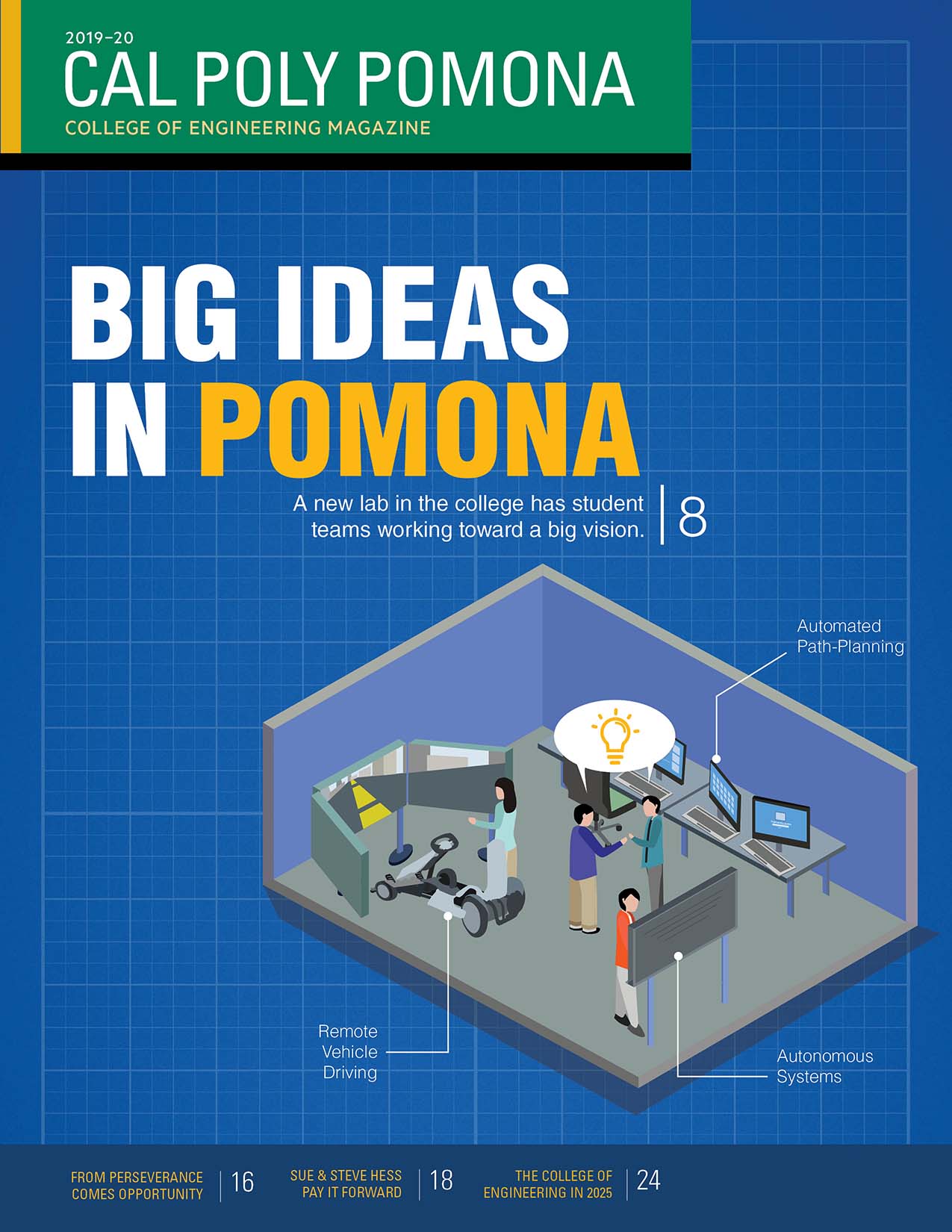 |
Read the 2019-20 edition of the Cal Poly Pomona College of Engineering magazine here. |
PROUD FATHER OF A NEW INDUSTRY
At that moment, Netwig became the father of the RO membrane chemistry industry. “I’ve always had a passion for chemistry,” he says. “After all my research, I began to see the benefits and clear need for RO water purification in a wide spectrum of manufacturing, municipal, and saltwater desalinization applications, so I set out to optimize the technology, making RO system maintenance more user-friendly and cost-effective.”
Based on his discoveries, Netwig founded King Lee Technologies in 1977. To this day, the company leads the RO chemistry industry, helping municipalities, manufacturers, and large and small desalinization system users improve the efficiencies of their RO systems.
King Lee Technologies offers several product lines to make RO system maintenance easier and more effective.
Their products are designed to treat specific types of feed water: silica-rich, or hard, brackish, and even seawater.
Armed with his Cal Poly Pomona engineering degree, a master’s degree in environmental science, and a reputation as an innovator and problem solver, Netwig took on new challenges. In the 1980s, Scripps Hospital in La Jolla sought Netwig’s expertise to design an ozone water purification system for their kidney dialysis department—it was used for many years. Later, he pioneered successfully the rebuilding of large RO system filter membranes to extend their useful life and reduce operating costs. Today, under his leadership, King Lee Technologies is still leading the way in developing new technology to improve the RO water purification system process. King Lee Technologies’ latest innovations are a patent pending software program that allows RO system users to remotely monitor and maintain their RO water purification system and a remotely controlled and monitored RO pilot unit.
THE CAL POLY POMONA WAY
Netwig gives much credit to his education at the College of Engineering. He recalls, “Back then, engineering students worked on senior projects individually. That put a huge responsibility on us to think creatively and solve engineering problems on our own. Also, it helped that the lab work was very practical, problem-solving oriented and hands-on, which I am happy to see remains a hallmark of the Cal Poly Pomona engineering program today.”
"I am happy to see the pioneering technology I developed for the water purification industry is being taken to the next level by faculty and students in the Cal Poly Pomona College of Engineering.” - Craig Netwig ('71, chemical engineering)
With a dedication to improving RO water purification technology and a strong appreciation for Cal Poly Pomona, in 2018 he provided funding to the College of Engineering for research into water re-use systems. His financial support enabled a student team, led by mechanical engineering assistant professor Dr. Reza Baghaei Lakeh and civil engineering associate professor Dr. Ali Sharbat, to build the Decentralized Renewable Off-Grid Water Treatment (DROWT) device. This innovative solar-powered RO system promises to help water-distressed communities with limited access to electricity reuse grey (non-drinkable) water for applications like dish and clothes washing. DROWT has become a multi-year, interdisciplinary and award-winning project that has garnered campus and state awards.
“American-trained engineers have always been pioneering and developing new technology to solve problems and improve the lives of people worldwide,” says Netwig. “What I’ve accomplished in the water industry resulted from realizing, soon after I graduated from Cal Poly Pomona with my chemical engineering degree, the need, opportunity, and confidence in my ability to lead the way in improving water quality worldwide. I am happy to see the pioneering technology I developed for the water purification industry is being taken to the next level by faculty and students in the Cal Poly Pomona College of Engineering.”